
The short answer
Assign upper-cabinet shelves by both reach and weight. Put daily lightweight dishes and glasses on the lowest comfortable shelves, use the top shelf for light occasional items in handled bins, add risers only where they improve visibility, and use a stable step stool rather than climbing on counters or chairs.
What to gather before you start
- A sturdy step stool that lives near the kitchen
- A tape measure for shelf height and depth
- One or two shelf risers, or a helper shelf
- A few light handled bins for the top shelf
- Non-slip liner for glass and dish shelves
- A relocate box for things that shouldn't be up high
Measure first. Buy only the pieces that solve a specific access problem.
Empty one shelf at a time and sort as you go
Work one shelf at a time so the kitchen remains functional. Remove the contents, wipe the shelf, and group like-use items on the counter: everyday drinkware, plates, baking ingredients, serving pieces, mugs, or occasional appliances. Discard chipped or unsafe pieces and relocate categories that do not belong near the task area.
Measure shelf width, depth, and vertical clearance before adding risers or bins. Note where the door hinges reduce usable width and whether shelves are adjustable. A shelf insert should improve access, not create a second dark row or prevent the door from closing.
Record the actual shelf width, depth, vertical clearance, and hinge intrusion before adding a riser or bin. Adjustable shelves can often be repositioned to fit the category more efficiently, but the door still needs to close and the items still need to lift out cleanly. Work shelf by shelf so the kitchen remains usable during the reset. Check shelf pins and adjustable holes while the cabinet is empty. A loose pin, cracked shelf edge, or bowed shelf should be corrected before heavy dishes or jars are returned.

Assign shelves by reach and weight
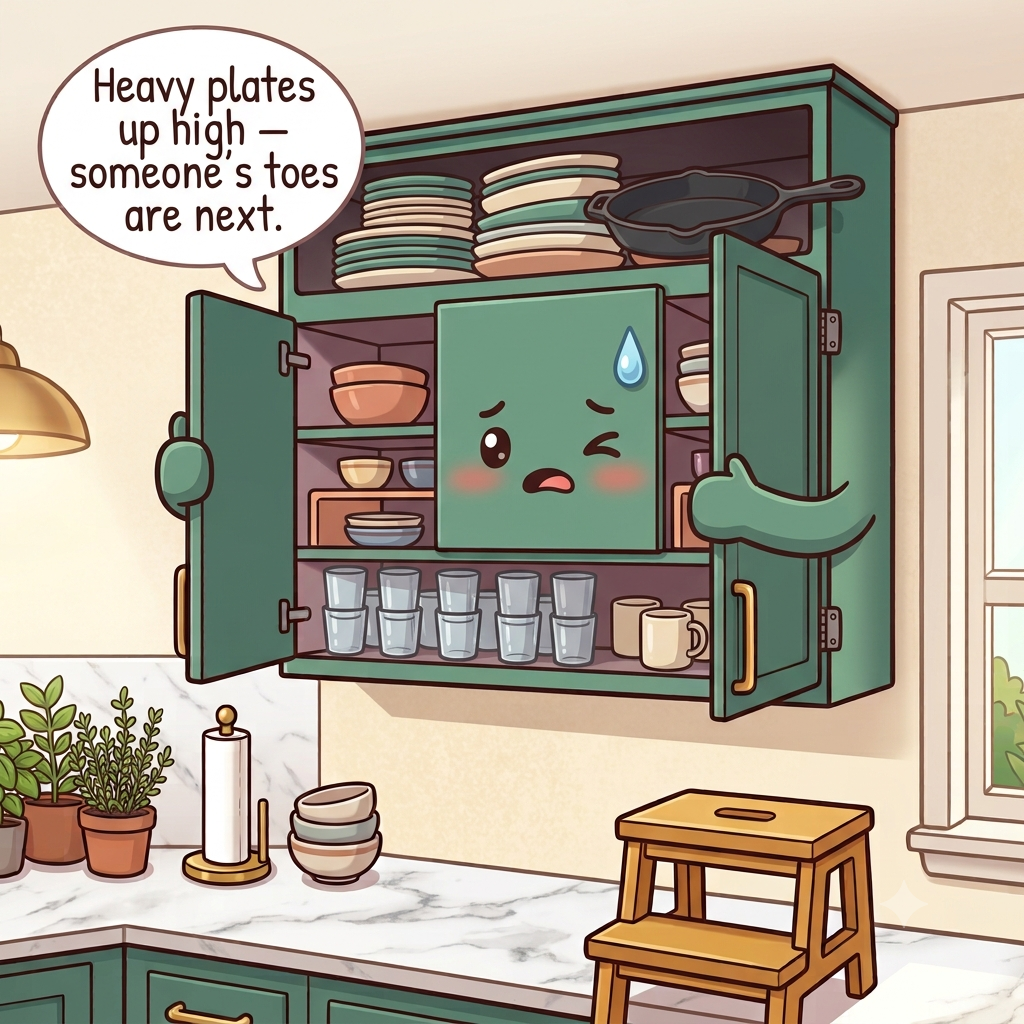
Use the lowest comfortable upper shelf for things you handle every day and can lift safely, such as glasses, mugs, and lightweight dishes. Higher shelves are better for light, less-used pieces. Avoid putting heavy appliances, stacks of dense cookware, or oversized glass serving pieces above shoulder height if another lower location is available.
Keep frequently used items within easy reach so you do not stretch while holding weight. If multiple people use the kitchen, set the active zone for the shortest regular user when practical. Children should not need to climb furniture to reach daily dishes; provide a safe lower location for child-use items.
Use reach as the first filter and weight as the second. Daily glasses and lightweight dishes belong where the shortest regular user can reach them safely when practical; dense cookware and heavy appliances are poor candidates for upper storage. Child-use dishes should have a safe reachable home rather than encouraging climbing. When a commonly used item requires standing on tiptoe while carrying weight, move that item or the entire category lower. Repeated awkward reaches are a layout problem, not a habit to train around.
Make the unreachable top shelf work
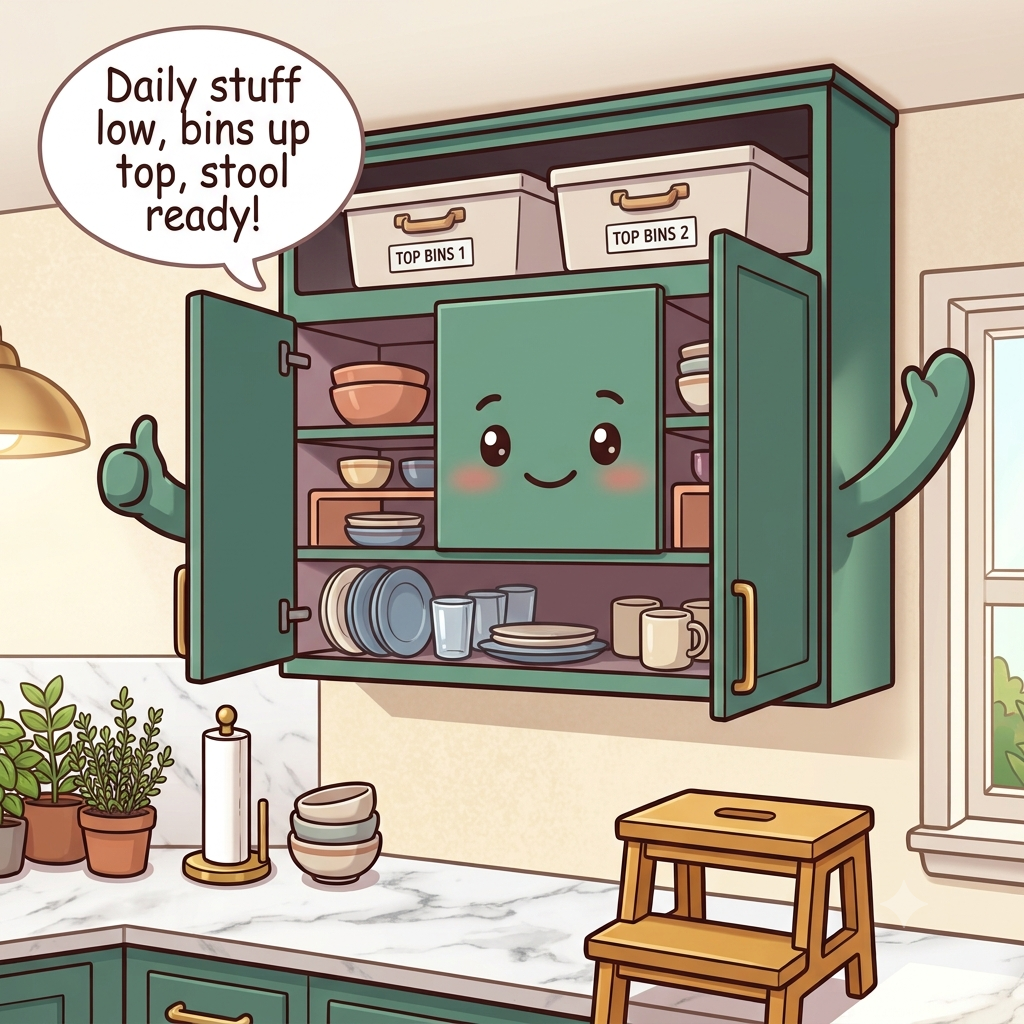
Treat the top shelf as reserve storage, not a place for daily retrieval. Put lightweight seasonal or occasional items in a small handled bin so you can bring the entire category down at once. Label the front edge with large, simple words that can be read from below.
Use a stable step stool that is designed for climbing and place it on a level floor; do not stand on a counter, rolling chair, or cabinet shelf. If a top shelf requires awkward lifting even with a proper stool, move the item lower. Retrieval safety is a better capacity limit than the shelf's empty volume.
Keep top-shelf categories light and infrequent, then contain them so the whole group can come down at once. A handled bin is more controllable than several loose items scattered at the back. Use a proper stable step stool on a level floor and move the category lower if retrieval still requires awkward reaching or lifting.
Use vertical space without burying the back
A shelf riser can create a second visible level for cups, small bowls, or short pantry items. Under-shelf baskets can work for lightweight pieces if they fit securely and do not overload the shelf edge. Use narrow bins with handles for packets or baking supplies when the cabinet is deep.
Avoid stacking so high that the lower item cannot be removed without lifting the whole tower. Keep glasses and fragile dishes in stable rows, and do not create a hidden back layer simply to use every inch. Visibility and one-handed retrieval are more valuable than maximum density.
A riser is helpful when it creates two visible levels, not when it simply doubles the hidden inventory. Under-shelf baskets should hold lightweight items and fit securely according to their instructions. In a deep cabinet, narrow handled bins can bring packets forward, but fragile dishes should remain in stable rows rather than buried behind one another. Plate racks and shelf risers should sit flat and stable before they are loaded. If a riser shifts when one mug is removed, reduce the load or choose a better-fitting insert rather than wedging it in place.
Load by how the kitchen actually flows
Place drinking glasses near the sink or dishwasher, mugs near the coffee setup, plates near the serving area, and baking ingredients near the prep zone when the layout allows it. This shortens carrying distance and makes unloading easier. The cabinet map should reflect repeated actions rather than matching categories for appearance.
Leave a small amount of breathing room around each active category so dishes can be returned without rearranging a stack. If one shelf continually overflows, reduce duplicates or move the occasional items instead of pushing daily pieces onto the top shelf.
Run one normal unloading cycle before declaring the map finished. Put away a dishwasher load or a set of washed dishes and count the awkward crossings: if glasses travel across the kitchen, mugs require moving another category, or the shortest regular user still needs a stool for daily pieces, reassign the cabinet jobs. The best layout reduces repeated carrying while keeping heavy and fragile items in a controllable reach zone.
Where upper kitchen cabinets go wrong
Do not put the heaviest items on the highest shelf, climb on counters, or install a riser that wobbles under dishes. Avoid two deep rows of identical-looking cans or glassware where the back cannot be seen. Do not buy shelf inserts until you have measured the cabinet and the items they need to hold.
Another mistake is treating every upper cabinet the same. A cabinet over the refrigerator may be suitable only for light, rarely used items, while a cabinet by the dishwasher can be prime daily storage. Let reach, weight, and workflow determine the job.
Avoid heavy items overhead, wobbling shelf risers, standing on counters or chairs, and hidden double rows that cannot be seen. Do not assume the cabinet over the refrigerator should hold the same type of items as the one beside the dishwasher. Let reach, weight, and workflow define each cabinet separately. Keep the area in front of upper cabinets clear enough to place a step stool flat on the floor. A safe retrieval setup includes the space below the cabinet, not just the shelf arrangement above.
The seasonal step-up reset
Every season, use a stable step stool to inspect top shelves for forgotten duplicates, expired food, and items that have become too heavy or awkward to retrieve safely. Wipe the shelf and bring anything newly frequent down into the active zone.
At the same time, check that risers, shelf pins, and bins remain stable and within their manufacturer load limits. If a high shelf has become a permanent graveyard, remove the category rather than adding another container.
At the seasonal check, inspect the high shelves with a stable step stool, remove forgotten duplicates, and bring newly frequent items down. Check shelf pins, risers, and bins for stability and follow their load ratings. If a top shelf has become a permanent graveyard, reduce what is stored there rather than adding another organizer. Clean the high shelf while it is partly empty and verify that labels on reserve food or serving pieces can still be read from the front. Anything invisible from below is more likely to become forgotten stock.
Renter-friendly option
Use freestanding shelf risers, handled bins, and a stable step stool rather than adding permanent shelves. Keep the heaviest items on lower shelves where they can be controlled safely.
30-second success check
- Daily items are reachable by the shortest regular user without stretching while holding a heavy or fragile load.
- The highest shelf contains only light, infrequent items that can be controlled from a proper step stool.
- Risers and shelf inserts sit flat and do not create a hidden back row.
- A normal dishwasher-unloading cycle does not require repeated cross-kitchen carrying for daily dishes.
Questions that come up
Frequently asked questions
Part of Kitchen Cabinets & Work Zones — 8 guides.