The short answer
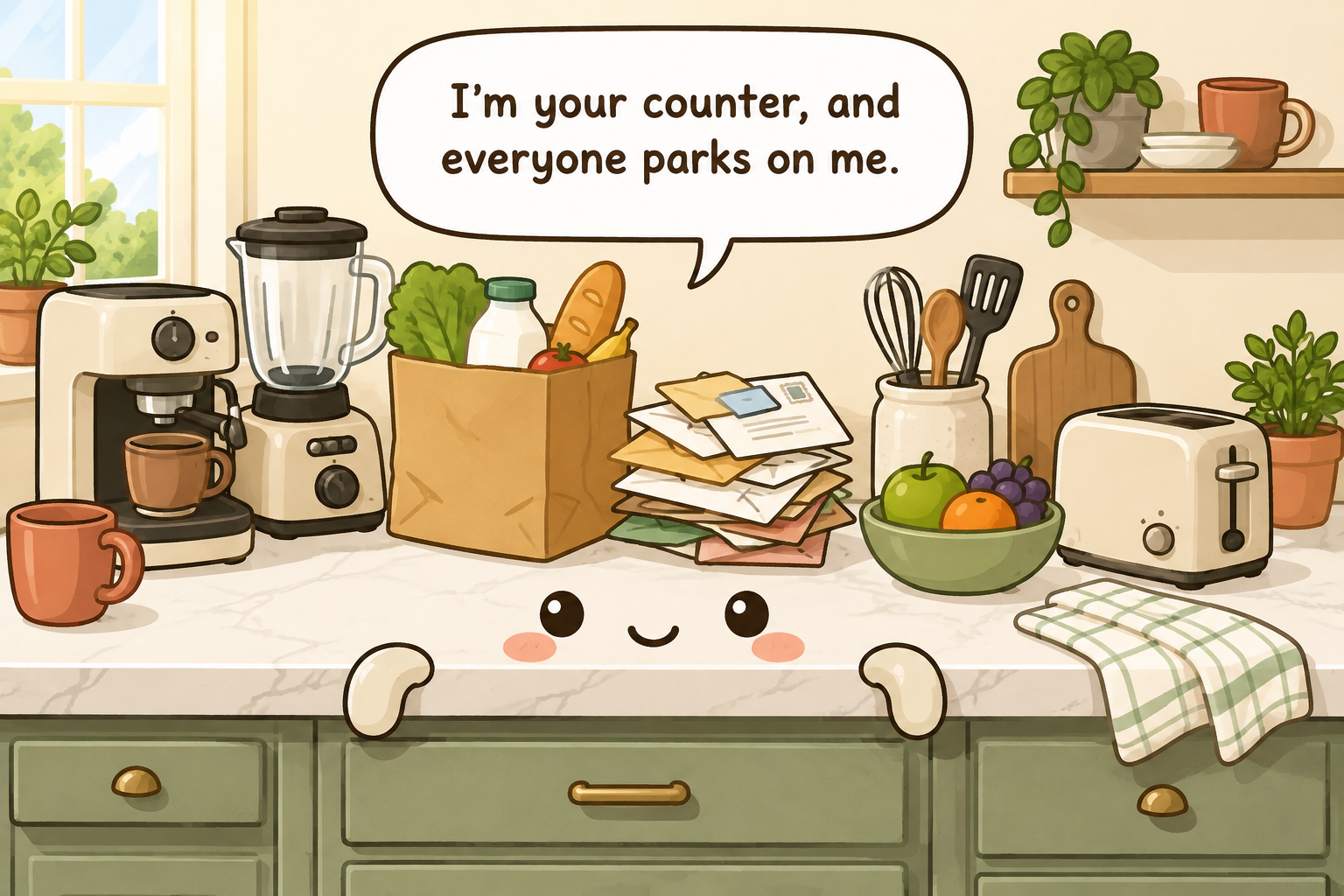
Protect countertop space for food prep and cooking rather than storage. Keep only appliances used often enough to justify their footprint, create clear prep, cooking, and serving zones, route mail and paperwork out of the kitchen, keep knives, medicines, and breakables away from casual edge zones, and finish each cooking session by returning ingredients, washing tools, and wiping the work surface.
What to gather before you start
- A tape measure and painter's tape
- One tray for a true daily-use station
- A small basket for items that belong elsewhere
- Vertical storage for boards or sheet pans
- Removable hooks or an over-door solution where appropriate
- A safe dedicated knife-storage method
Measure first. Buy only the pieces that solve a specific access problem.
Give it a landing strip before you clear everything else
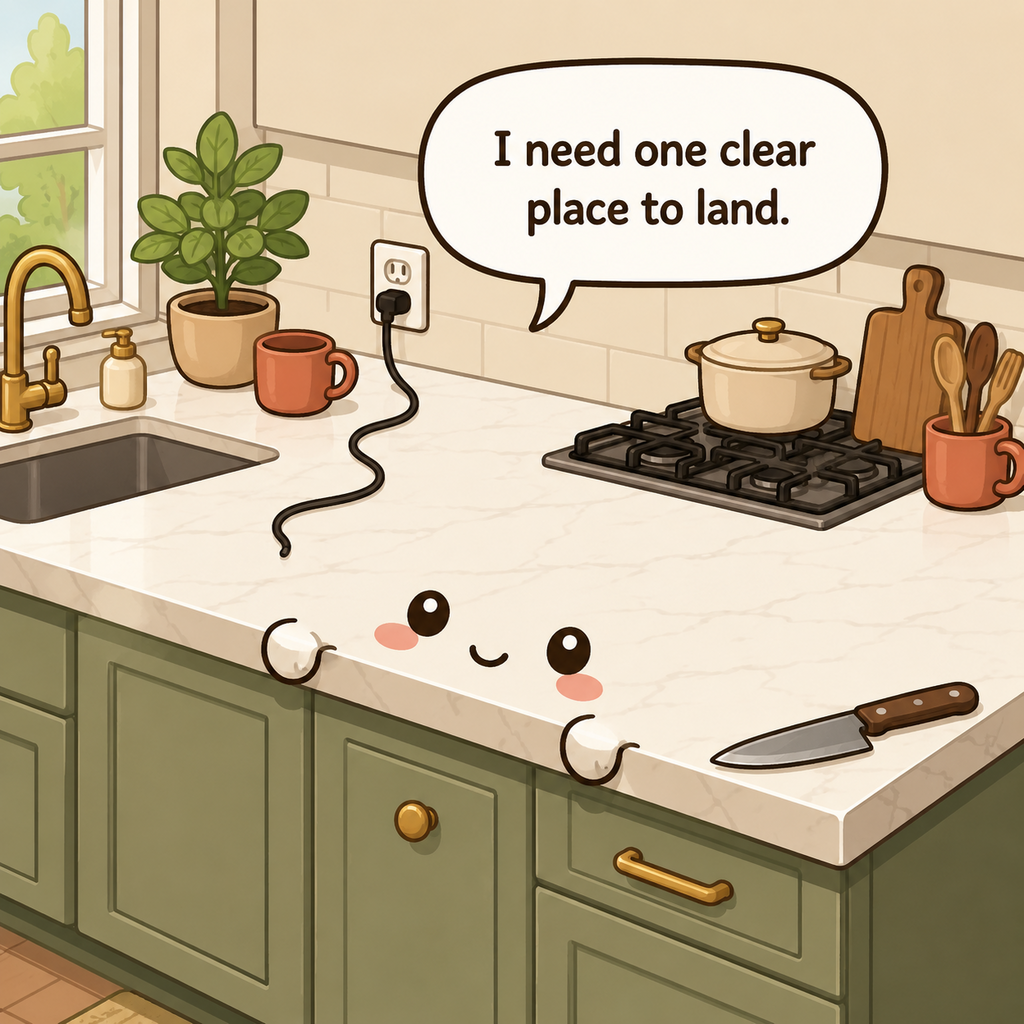
Choose one small, deliberate landing area for the few objects that genuinely arrive in the kitchen, such as keys or a grocery list, and keep it away from food-prep space. Use a tray or a narrow section with a hard boundary. Without a defined landing strip, clearing the rest of the counter often just moves the same incoming clutter around.
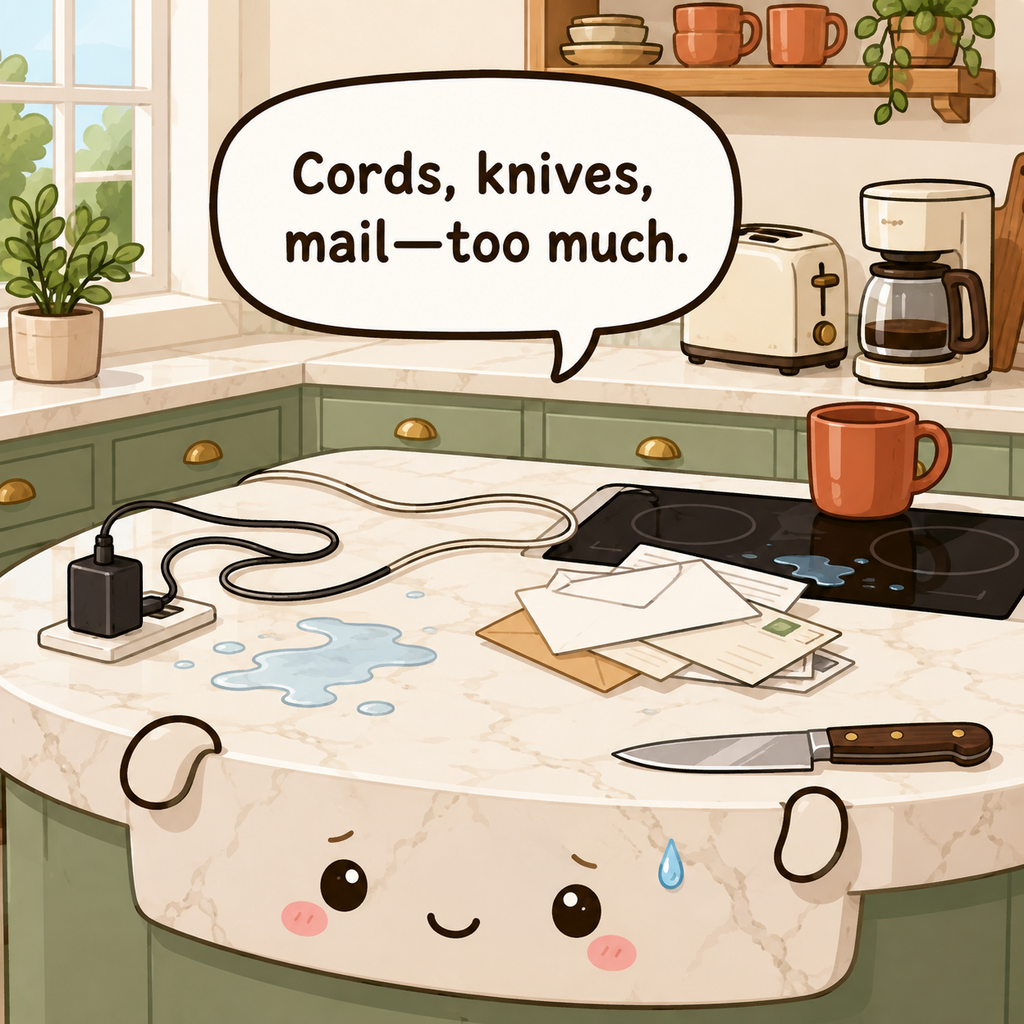
Do not place the landing area beside the cooktop, sink splash zone, or countertop edge where items can fall or get wet. Mail, school papers, receipts, and packages should leave the kitchen for a paper-processing location rather than expanding the landing strip.
Measure only the countertop that remains usable after sink splash, cooktop heat, appliance doors, and food-prep space are respected. A tray that fits the stone may still sit in the wrong place if it crowds a hot appliance or steals the only chopping area. Mark the landing strip small enough that it cannot expand into the prep zone, and move anything that does not belong to the next kitchen task out of the room.
Make every appliance earn rent with frequency
Keep an appliance on the counter when it is used frequently enough that putting it away would create real friction and there is safe space around it. Coffee makers, kettles, or toasters may qualify in one household while a stand mixer or blender may not. Move occasional appliances to a lower cabinet or pantry shelf that can safely carry the weight.
Follow each appliance's ventilation, heat, and clearance instructions. Do not crowd hot appliances under cabinets or next to flammable clutter, and unplug appliances when the manufacturer recommends it. A clear counter is not useful if the remaining appliances are packed unsafely.
Judge each appliance by both frequency and safe operating space. A toaster used every morning may deserve a permanent spot; a mixer used twice a month may be easier to store on a sturdy low shelf. Follow the appliance manual for ventilation and clearances rather than pushing machines tightly under cabinets for a cleaner look. If the appliance cannot operate safely where it sits, it has not earned that countertop location.
Build three working zones instead of one decorative counter
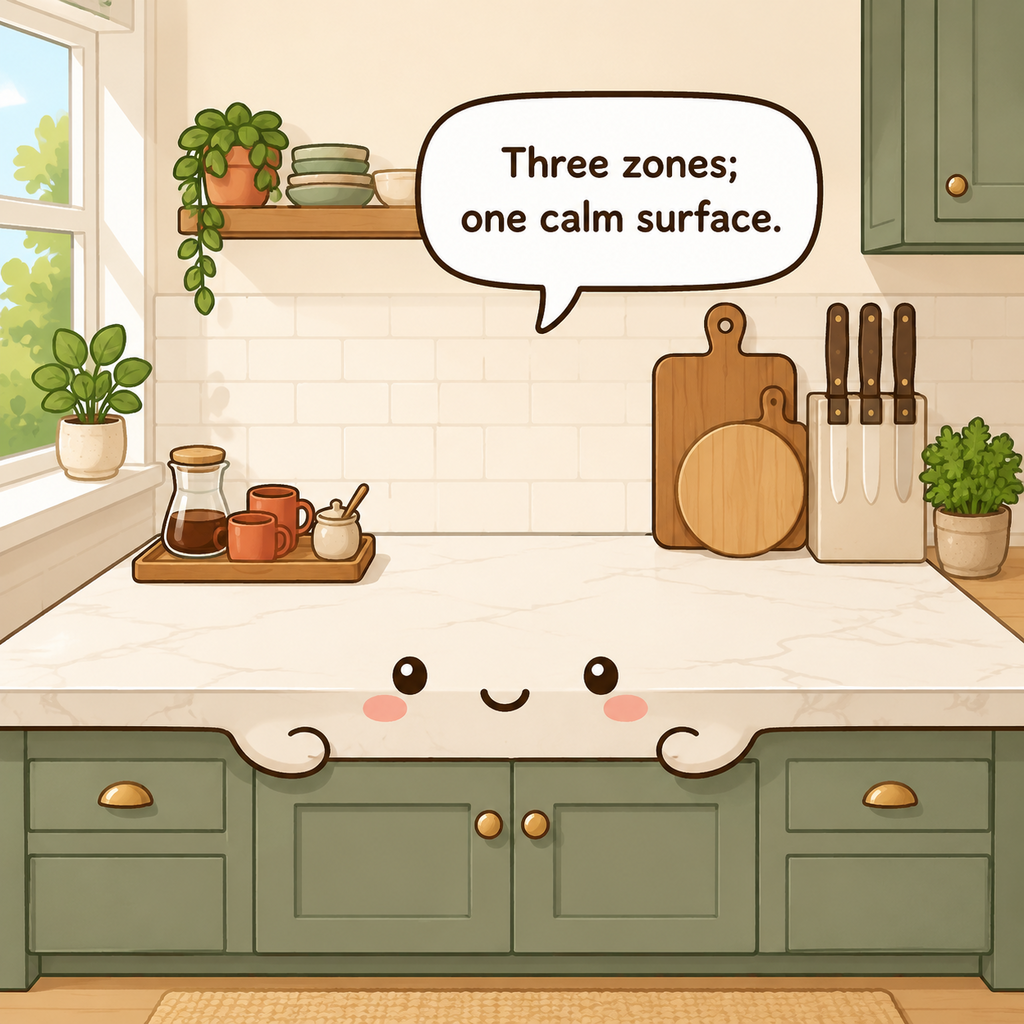
Reserve a prep zone near the refrigerator or sink, a cooking-support zone near the range without crowding heat sources, and a serving or plating zone where finished food can land. Keep each zone mostly clear until its task begins. Frequently used tools should live in the nearest drawer or cabinet, not permanently across the work surface.
Adjust the zones to the actual kitchen layout; a small galley may have one section that changes jobs through the meal. The principle is to give active work first claim on the counter instead of decorating every open foot with canisters and trays.
Keep the three zones visually simple so they can change jobs during a meal. The prep area needs room for a board and ingredients, the cooking-support zone needs safe access without storing combustibles beside heat, and the plating area needs an empty landing surface. Store the supporting tools in the nearest drawer or cabinet. The goal is less reaching while cooking, not permanent countertop displays that consume the working surface.
Move paper out before it becomes part of the kitchen
Handle mail and school paper at a separate command center, wall file, desk, or small lidded box away from food and water. In the kitchen, keep only the recipe or list needed for the current task. Paper near sinks, grease, food spills, and heat becomes damaged and is easy to ignore once it forms a stack.
Protect sensitive records from casual exposure and shred documents with account numbers, Social Security numbers, signatures, or other personal information when they no longer need to be retained. Do not use an open countertop basket as permanent record storage.
Give paper a route that ends outside the kitchen: recycle obvious junk immediately, put action items in one portable file or command center, and move records to secure storage. If a recipe is on paper, keep only that sheet in the work zone and move it away from water and heat. Sensitive mail should never sit exposed as countertop decor; process or secure it while the kitchen surface remains dedicated to food work.
Keep knives, medicines, and breakables out of the casual edge zone
Store knives in a block, in-drawer knife tray, magnetic system installed and used appropriately, or another secure holder where blades are protected. In homes with children, sharp tools should be inaccessible to them. Keep glass jars, heavy crocks, and breakables away from the outer edge where a sleeve, bag, or child can knock them down.
Medicines should follow their label storage instructions and be secured from children and pets; a kitchen counter near heat, sun, food, and spills is rarely a good default. Never leave household chemicals on the food-prep counter after use.
Create a protected edge zone by moving knives, medicines, heavy glass, and fragile crocks inward or into dedicated storage. Knife blocks and magnetic holders must be stable and used as designed, while drawers need inserts that cover or separate blades. Medicines belong wherever their labels specify and where children and pets cannot access them. Do not trade safe storage for a visually empty drawer or a styled countertop vignette.
Use the wall and cabinet doors for light tools, not heavy clutter
A rail for light utensils, a paper-towel holder, or a small magnetic or adhesive accessory can move a frequent item off the counter when the wall and hardware support it. Keep hanging storage shallow so it does not interfere with food preparation or make cleaning harder.
Follow load instructions and mount permanent hardware appropriately. Renters can use removable hooks rated for the surface and load, over-door cabinet organizers, or freestanding vertical holders. Do not hang heavy appliances, glass jars, or overloaded baskets above the work zone.
Use vertical storage for genuinely light, frequently used tools only. A properly installed rail can hold utensils; a removable hook may hold a light towel if the surface and load rating allow it. Keep hanging items away from flames, hot appliances, and the main chopping path. Renters should choose no-drill options that can be removed cleanly, but even removable hardware needs its rated load respected.
End every cooking session with a closing shift
After cooking, put ingredients back, move leftovers into safe storage, load or wash dishes, wipe spills, return knives and tools, and reset the landing strip. Treat this as part of cooking rather than a separate housekeeping project. The counter should be ready for the next meal before the kitchen closes.
If one appliance, paper pile, or food category is consistently left out, decide whether it deserves a permanent safe home or whether the return path is too inconvenient. Fixing that friction is more effective than repeatedly clearing the same object.
Make the closing shift part of the last cooking step: refrigerate leftovers promptly, put ingredients away, return knives, wash or load tools, wipe spills, and clear the landing strip. If the same item remains out every night, either give it a safe permanent home or make its storage easier to reach. Repeatedly moving one awkward appliance is a layout problem; repeated mail piles are a routing problem.
Where kitchen countertops go wrong again
Do not turn every open section into decorative storage, keep rarely used appliances permanently out, let paper live beside food prep, or store knives and medicines in casual child-accessible edge zones. Avoid hanging heavy items from unverified hooks and crowding heat-producing appliances.
Another mistake is clearing the counter without changing where incoming items go. Give recurring clutter an exit route before buying trays and baskets, or the new containers will simply make the pile look intentional.
When clutter returns, identify which boundary failed. A crowded prep zone means too many permanent objects; a growing tray means the landing strip has become storage; papers beside the sink mean the paper route is inconvenient. Correct that one failure before buying another organizer. Extra trays can make clutter look intentional while still removing the clear workspace the kitchen needs.
The nightly reset
Each night, return stray food and appliances, process the landing strip, move paper to its real system, and wipe the work surface. Leave at least the main prep zone completely open so breakfast does not begin by moving last night's clutter.
Once a week, question any object that has stayed on the counter for seven days without being used. Move it to a cabinet or another room unless it has earned permanent space through frequent use.
Each night, leave the main prep area visibly empty, not merely rearranged. Return appliance accessories, clear incoming items, and wipe the surface so the next meal begins without moving yesterday's objects. Once a week, question anything that has occupied the counter without being used. If an item is only occasionally needed, relocate it to safe cabinet or pantry storage and reclaim the work surface.
Counter-edge safety
- Keep knives and sharp tools in secure storage, not loose at the counter edge.
- Keep medication away from heat, moisture, food-prep contamination, and children.
- Keep breakables and hot appliances away from casual edge zones where they can be pulled down.
Sources: U.S. CPSC — Poison Prevention; U.S. FDA — OTC medicine storage guidance
Renter-friendly option
Use freestanding utensil holders, under-shelf accessories that require no drilling, over-door cabinet organizers, and removable hooks rated for the surface and load. Keep removable storage away from heat and do not hang heavy or breakable items above the prep zone.
30-second success check
- The main food-prep zone is completely usable without first moving decorative storage.
- Only frequently used appliances remain out, with their manufacturer-required ventilation and heat clearances respected.
- Mail and paperwork leave the kitchen through a defined route.
- Knives, medicines, chemicals, heavy glass, and breakables are not left in casual child-accessible edge zones.
- The nightly closing routine leaves the main work surface visibly clear.
Questions that come up
Frequently asked questions
Part of Kitchen Cabinets & Work Zones — 8 guides.