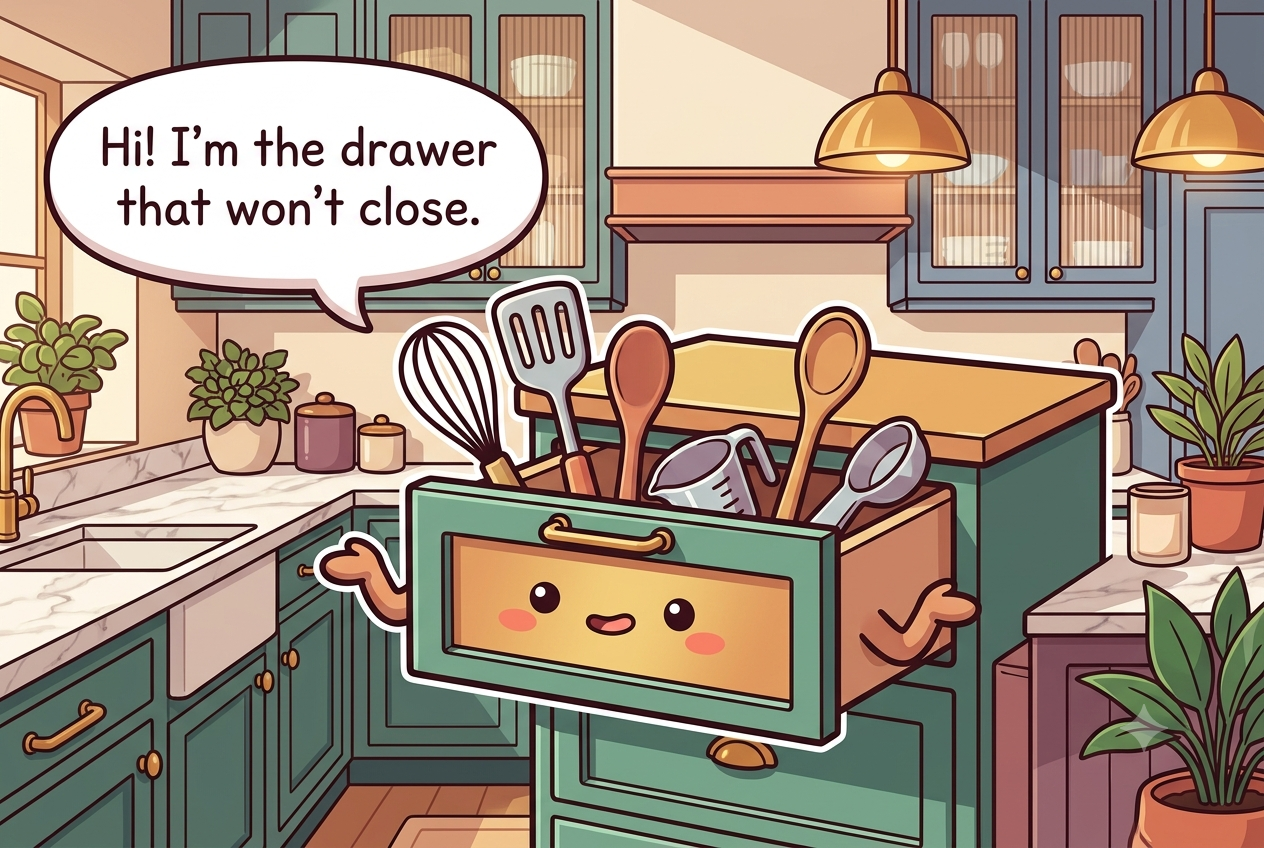
The short answer
Start with the utensil that catches on the drawer box or countertop, then measure the drawer's internal height before deciding what can stay. Keep only frequently used tools in one visible layer, group them by cooking task in low dividers, put bulky or rarely used gadgets elsewhere, and leave enough clearance that nothing rotates upright and jams the drawer.
What to gather before you start
- A ruler for the drawer's inside height, not just width and depth
- Adjustable drawer dividers or a set of open trays
- A non-slip liner if the trays shift
- A counter crock or a taller drawer elsewhere for oversized tools
- A relocate basket and a donation bag
- Labels, only if a section isn't obvious
Measure first. Buy only the pieces that solve a specific access problem.
Empty it and find the tool that jams it
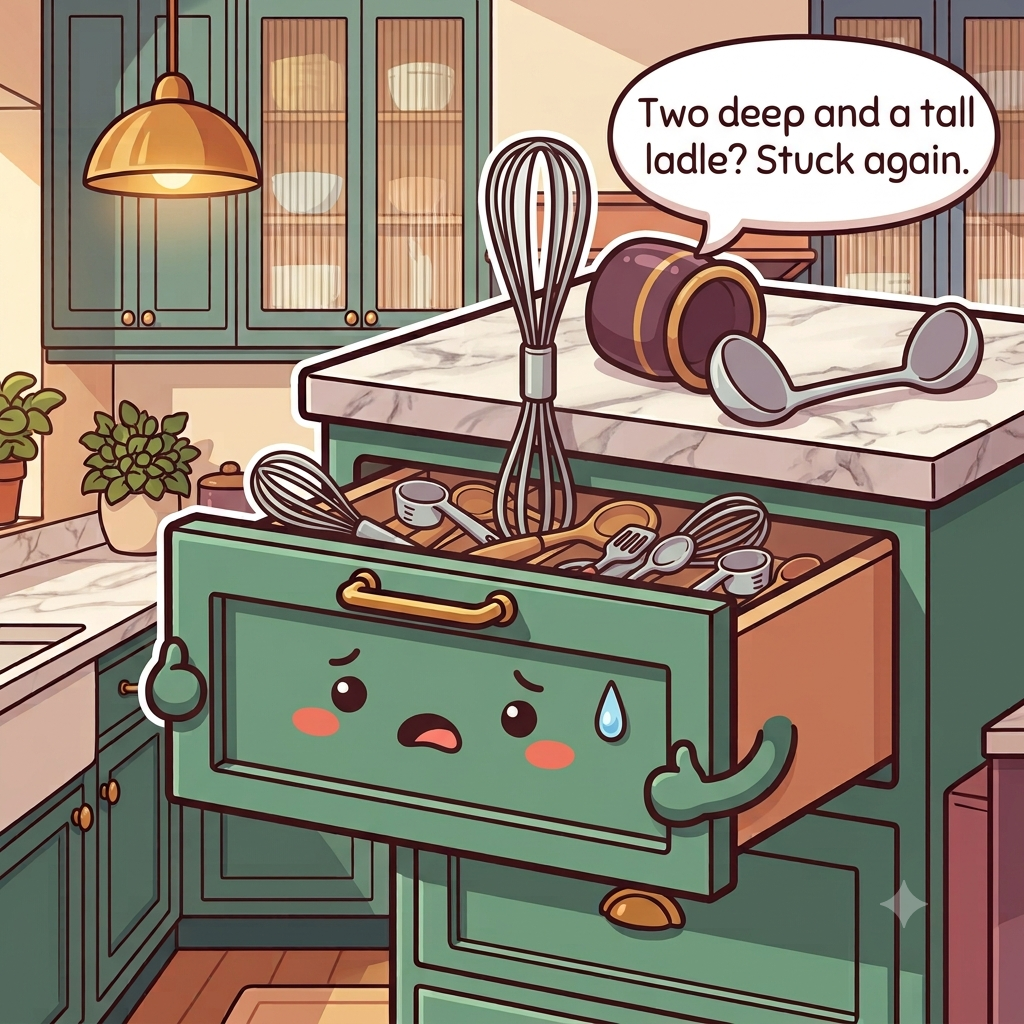
Remove every utensil and open and close the empty drawer to confirm the slides work normally. Then identify long-handled, bulky, or top-heavy tools that can rotate upward and catch the cabinet frame. Common offenders include ladles, potato mashers, whisks, tongs, and oversized spatulas that are taller than the usable drawer box when they tip.
Check for broken handles, duplicate gadgets, and tools you no longer use. Wipe crumbs from the drawer and inspect the slides. If the drawer still binds when empty, address the hardware problem rather than assuming organization will fix it.
Measure the clear internal height with the drawer fully closed, not just the sidewall height. Long whisks, ladles, and turners can catch on a rail or cabinet frame even when they fit diagonally. Remove duplicate gadgets and relocate oversized tools before buying inserts for a drawer that is physically too shallow. Pay attention to handles that swell or twist, such as bulky peelers, can openers, or pizza cutters. A drawer may appear fine when open but jam when one handle rotates upright during closing. Remove or relocate those problem shapes first.

Measure the height, then decide what fits
Measure from the drawer bottom to the lowest obstruction above the drawer as well as the drawer's length and width. A utensil can be shorter than the drawer but still jam if its handle rolls or a divider raises it too high. Test tall tools flat before committing them to the drawer.
Move oversized tools to a countertop crock, deep cabinet bin, wall rail, or another location where they can stand safely. Renters can use a freestanding utensil crock or removable adhesive hooks rated for light tools rather than drilling a rail into the backsplash.
Lay the tallest keeper flat and slide the drawer shut before choosing dividers. If a tool must sit on top of another or be angled to clear the frame, it belongs in a crock, deeper drawer, or wall storage. Keep the drawer for tools that genuinely fit in one controlled layer.
Group by cooking task, not just by type
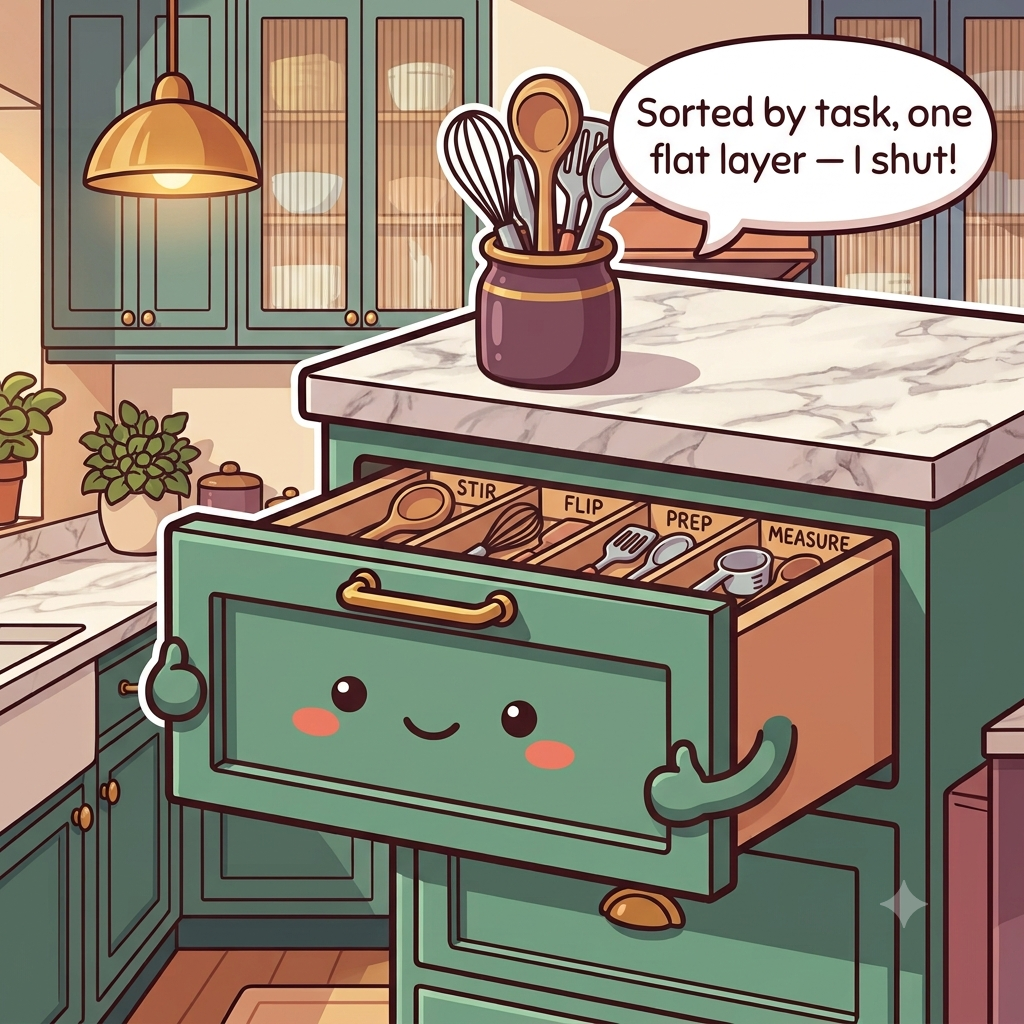
Make broad zones such as stirring and flipping, prep tools, measuring, and baking rather than a separate compartment for every shape. Keep tools that are used together close to one another. If a category contains ten near-identical spatulas, edit the duplicates before enlarging the compartment.
Place sharp blades, specialty slicers, or other cutting tools in protective storage appropriate to the item, not loose among wooden spoons. In homes with children, keep sharp tools in a secure location they cannot access, even if that means they do not live in the easiest utensil drawer.
Create broad working groups such as stirring, turning, measuring, and small prep so tools used together are near one another. Keep the categories simple enough to reset while cooking. A rigid taxonomy that separates every material or shape usually creates more sorting work than retrieval benefit. Keep tools used at the stove separate from baking or measuring tools when that shortens movement during cooking. A drawer beside the range should not also become the home for every gadget in the kitchen simply because the category is 'utensils.'
Keep it to one flat layer
Use low dividers or modular trays that keep utensils from crossing into one another while preserving vertical clearance. Aim for one visible layer in each lane; when tools are stacked three deep, the bottom becomes invisible and people drop new items on top instead of returning them to the right place.
Do not fill every centimeter with organizer walls. Long tools often need uninterrupted length, so a few adjustable dividers can work better than a fixed tray with small compartments. Leave room for handles to lie flat when the drawer closes.
Use shallow dividers or trays that keep handles from crossing without building a second hidden level. The active tools should be visible from above when the drawer opens. If the layer becomes crowded after buying a new utensil, remove the least-used duplicate before increasing the organizer footprint. If the drawer is unusually deep, resist the urge to stack a second tray unless the upper tray can slide or lift without hiding the lower tools. The brief should remain one visible working layer, not a disguised two-story storage system.
Keep the daily few at the front and make the rest earn space
Place your most-used spoon, spatula, tongs, and measuring tools at the front or on the side closest to the prep area. Move turkey basters, specialty peelers, decorating tools, and seasonal gadgets to a secondary drawer or labeled bin if they are used rarely.
Use a one-in, one-decision rule for new gadgets: before adding another tool, identify what job it performs and whether the drawer already holds a tool for that job. The drawer should not be the default home for every small kitchen object.
Place the spatula, tongs, measuring spoons, or other frequent tools nearest the hand position you naturally use. Move specialty tools toward the back only if they remain visible and easy to remove. If a gadget goes through several resets without use, give that drawer space to a tool that actually supports cooking. Use a seasonal or project-specific bin outside the drawer for tools such as turkey basters, canning tools, or specialty baking gadgets that appear only occasionally. Prime drawer space is for repeated cooking actions, not ownership history.
Where utensil drawers go wrong
Do not force a drawer closed when a tool catches; repeated pressure can damage the utensil or drawer hardware. Avoid tall stackable organizers that reduce clearance, loose sharp blades, and so many dividers that long utensils have nowhere to lie flat. Do not keep duplicate gadgets just because there is a narrow gap left.
Another mistake is organizing by appearance instead of use. A perfectly matched tray is not useful if the whisk still jams or the daily spatula is underneath six specialty tools. Solve the mechanical problem first.
Do not keep sharp blades loose, stack tools above the drawer's safe height, or use deep bins that hide handles underneath one another. Avoid buying a pre-shaped organizer before measuring your actual longest tools. A drawer that closes only when contents are rearranged is already over capacity. Keep frequently washed wooden or silicone tools fully dry before they return to a closed drawer, and follow material-care instructions when a tool begins to crack, split, or retain odor.
The weekly ten-second reset
Once a week, flatten any utensils that migrated diagonally, return tools to their broad zones, and remove items that belong in another drawer. Test that the drawer opens and closes freely without needing a shove.
When a new gadget enters the drawer, decide immediately whether it replaces something or deserves a new home. Small corrections prevent the jam from returning.
Once a week, straighten handles, return migrated tools, and remove any item that has started catching the drawer. Wipe crumbs from the bottom when needed and check that sharp or specialty tools have not drifted into the general layer. A tiny recurring reset prevents the familiar jam from rebuilding. If the same tool keeps landing diagonally across the drawer, give it a new home instead of forcing the existing layout. Repeated misplacement usually signals a poor fit or category choice, not a failure to remember the organizer. Use the same pass to remove packaging ties, takeout utensils, or duplicate gadgets that wandered in during the week so the working layer remains reserved for real cooking tools.
30-second success check
- The drawer opens and closes freely without a tall or diagonal tool catching.
- General utensils stay in one visible layer grouped by broad cooking task.
- Daily tools are nearest the front and duplicates have been edited.
- Sharp blades or specialty cutters are protected and inaccessible to children rather than loose in the drawer.
Questions that come up
Frequently asked questions
Part of Kitchen Cabinets & Work Zones — 8 guides.