The short answer
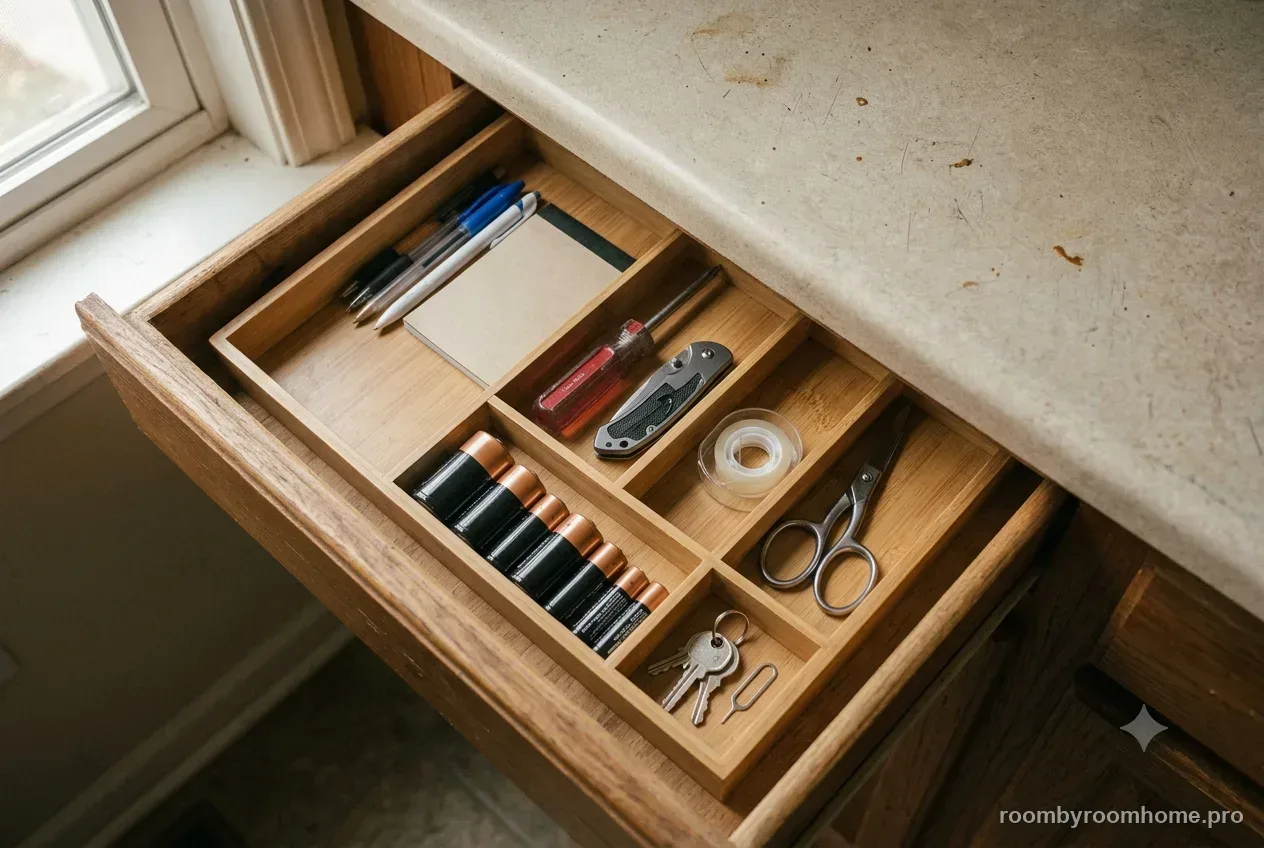
Empty the drawer, test every pen, battery-powered gadget, and mystery item, then decide exactly what the drawer is allowed to hold. Build a few useful categories first and fit shallow trays or adjustable dividers around those categories, leaving enough open space that every item remains visible.
What to gather before you start
- A tape measure or ruler
- Small open trays or adjustable drawer dividers
- A removable non-slip liner if trays slide
- A few small pouches or bands for loose cords
- Labels, only if the compartments aren't obvious
- A trash bag and a relocate basket
Measure first. Buy only the pieces that solve a specific access problem.
Turn the junk drawer into a defined utility drawer
Keep a small set of frequently used household odds and ends; move anything with a real category to that category.
- Keep only items that are genuinely useful in this location at least occasionally.
- Test pens, flashlights, batteries, keys, and small tools before giving them space.
- Measure the drawer interior and choose shallow trays only after the categories are known.
- Leave enough open space to see and remove each item without lifting a pile.
- Use one tiny landing section for unresolved items and empty it during the weekly reset.
Empty it out and test every loose thing
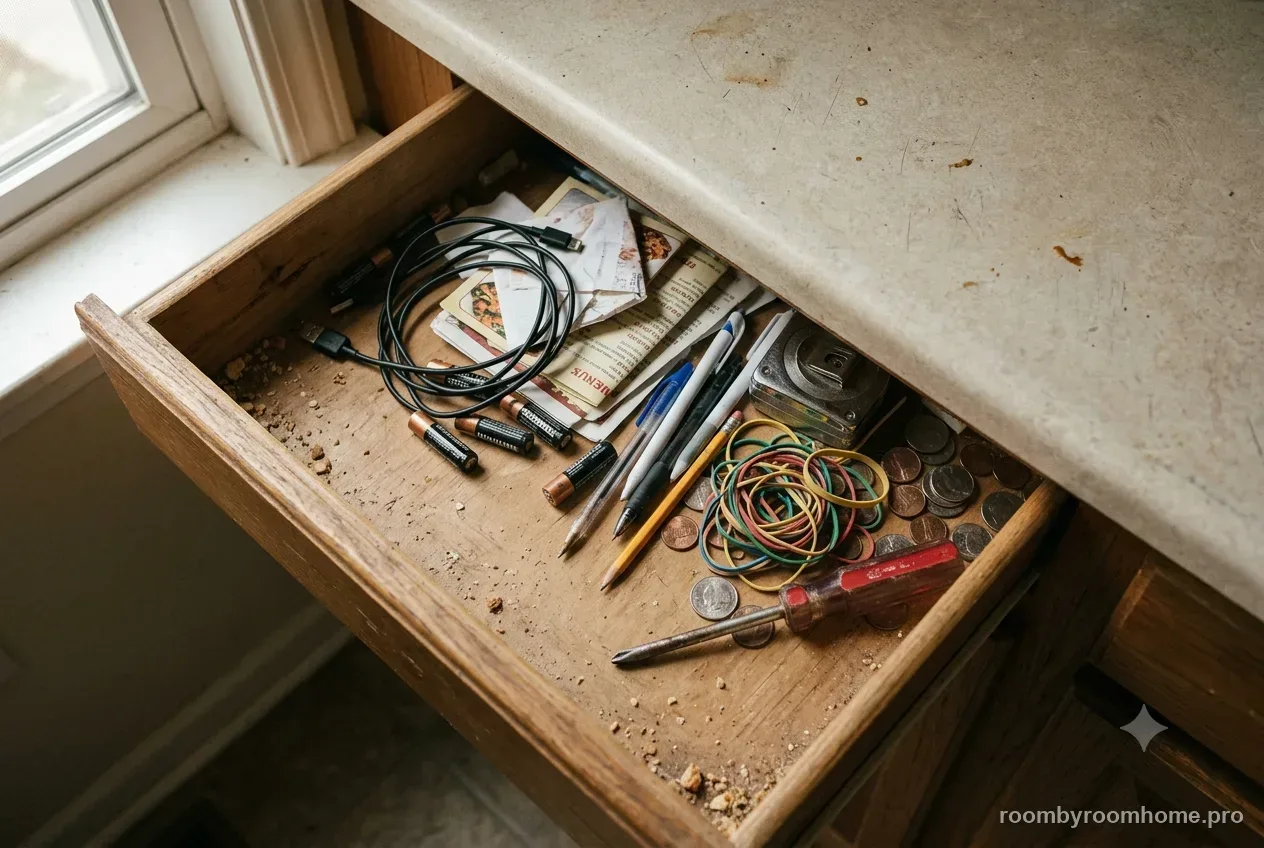
Empty the drawer onto a table and test anything that can fail. Try pens and markers, check flashlights, identify keys, discard broken rubber bands and dried glue, and separate batteries for proper recycling if they are spent or damaged. Move receipts, instruction manuals, medicine, loose food, and items that already have a better home out of the pile.
Wipe the drawer and measure its inside height before choosing trays. The most common junk-drawer problem is not a lack of dividers; it is keeping unverified objects because they might be useful someday. If you cannot identify a cable, key, or small part, give yourself a short verification window rather than letting it live anonymously for years.
Measure the inside width, depth, and usable height after the drawer is empty, including any rail or counter lip that limits tall items. Also identify the longest tool that truly belongs there. Those dimensions matter more than the outside size printed on an organizer package and prevent buying trays that make the drawer jam. For unknown keys or cables, photograph them and set a short household-wide identification deadline. If nobody can match the item to a lock or device by the reset, it should leave the active drawer.
Decide what the drawer is actually for
Give the drawer a job such as 'small household tools and daily utility items' rather than 'anything without a home.' A useful set might include a tape measure, a small screwdriver, scissors, pens, tape, a flashlight, reusable ties, and a limited number of frequently needed fasteners. Your list should reflect what people in the household actually reach for.
Once the purpose is clear, items that do not fit the job become easy decisions. Mail belongs in the paper system, cosmetics in personal storage, kitchen tools in the kitchen, and hardware quantities in a tool area. A narrow mission keeps the drawer convenient without turning it into a second storage room.
Write the drawer's job in one sentence and use it as the admission rule. If the drawer is for daily household utility items, a tape measure belongs; a stack of receipts does not. A narrow purpose also makes it obvious when a new object needs a permanent home elsewhere instead of becoming anonymous clutter.
Form categories before you buy dividers
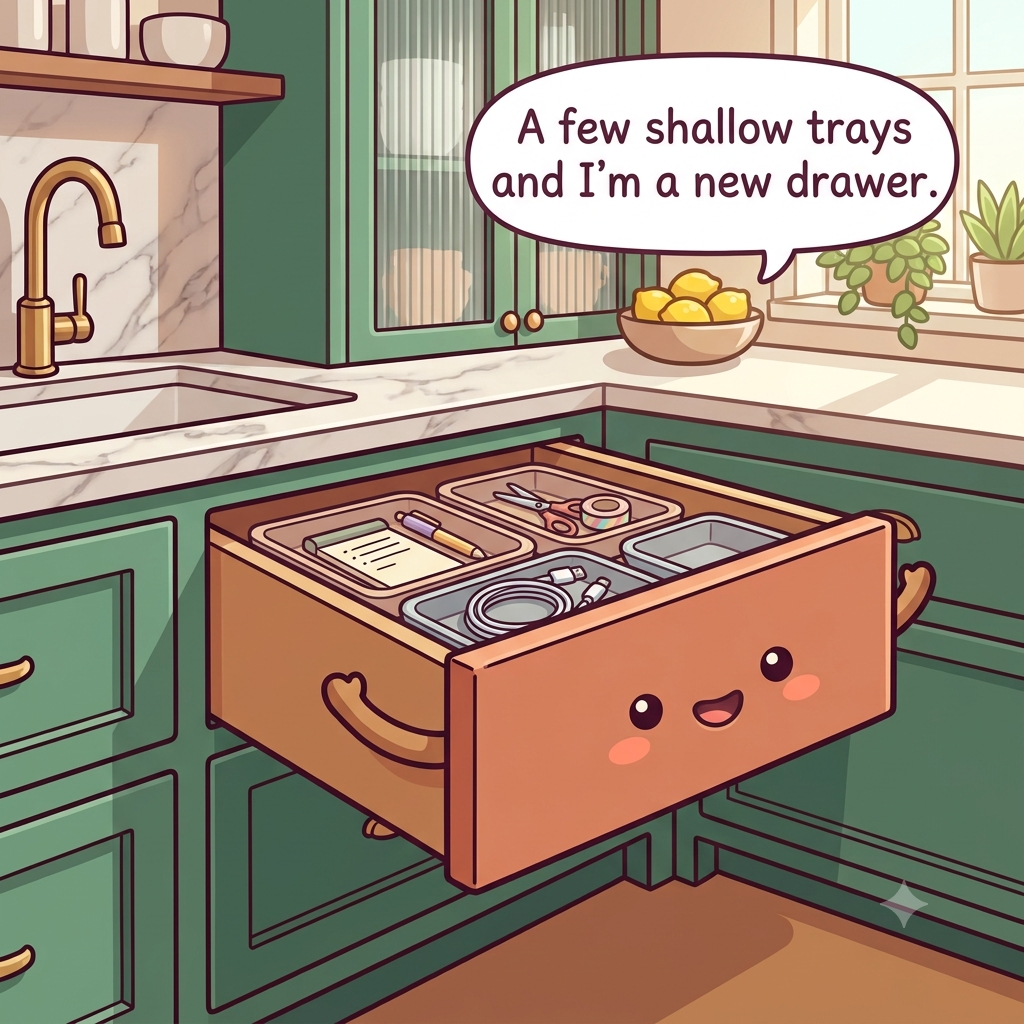
Group the keepers into a handful of categories—writing, measuring, cutting, fastening, charging, and small household repair, for example. Lay those groups inside the empty drawer and see how much space each truly needs. Only then choose shallow trays or adjustable dividers that fit the drawer's dimensions and the category sizes.
Avoid a pre-molded organizer with compartments that are too small for your real items. Mixed small trays are often more flexible because they can be rearranged when the contents change. Keep tall objects out if they make the drawer catch on the cabinet frame; no organizer fixes a drawer that is physically too shallow for its contents.
Dry-fit the categories in the empty drawer before buying anything. Long items may need an adjustable divider, while small items such as clips or reusable ties work better in shallow trays. Leave one small amount of breathing room so categories can be returned without exact packing; a zero-clearance layout usually collapses after the first rushed use. Test the layout by opening and closing the drawer several times with the real tools inside. Tall scissors, tape dispensers, and bulky adapters often reveal clearance problems that an empty tray does not.
Keep only duplicates you can see
Keep duplicates only when they are genuinely useful and can be counted at a glance. Two working pens and a spare roll of tape may be practical; fifteen nearly identical pens and a handful of mystery chargers are inventory, not convenience. Put bulk packs and long-term spares somewhere else and keep only the active quantity here.
Visibility is the limit. If duplicates must be piled in layers, you will stop knowing what you own and buy more. For loose batteries, protect terminals and follow local recycling or disposal guidance; do not let damaged or leaking cells roll around with metal objects.
Set the duplicate limit by visibility, not by an arbitrary number. If spare pens, batteries, or hooks have to sit in a second layer, move the bulk supply elsewhere and keep only an active amount here. Visibility prevents accidental rebuying and makes a missing or damaged item obvious during the weekly check.
Give it one small landing zone
Reserve one small tray for temporary objects that truly need a decision—a stray key to identify, a screw from a repair, or an adapter that needs to be matched to a device. Make that tray physically small so it cannot become a junk drawer inside the junk drawer.
Set an exit rule for the landing zone. When it fills, or during the weekly reset, identify, relocate, recycle, or discard the items before adding more. A bounded holding area is useful; an unlimited 'deal with later' category is how the drawer returns to its old state.
The temporary tray needs a deadline as well as a boundary. A mystery key, spare screw, or unidentified adapter can stay only until the next reset, when it is identified, relocated, recycled, or discarded. Keeping that decision zone deliberately small prevents it from becoming a second junk drawer inside the first.
Where junk-drawer systems break down
Do not buy dividers first, keep every promotional pen, save unidentified keys indefinitely, or let paper cover the small tools underneath. Avoid storing sharp blades loose, leaking batteries, medicine, food, or anything that could damage other contents. Do not turn the drawer into bulk storage for hardware or office supplies.
Another mistake is organizing for appearance rather than retrieval. Matching containers are optional; a drawer is successful when each category has a clear boundary and items can be put away with one hand. If a system requires lifting three trays to reach tape, it is too complicated for a high-turnover utility drawer.
A tidy-looking drawer can still be poorly organized if every retrieval requires moving another tray. Avoid deep stacked containers, loose sharp blades, leaking batteries, expired medicine, and unidentified cords. If one category constantly overflows, give that category a better home rather than expanding the catchall. Keep spare hardware with its project or tool category whenever possible; an unlabeled screw or bracket rarely becomes more identifiable after months in a utility drawer.

The Friday five-item reset
Once a week, take five things out of the drawer and make a decision about each one. Return misplaced items, test a questionable pen, identify a mystery part, recycle an empty battery package, or move bulk extras to their proper storage. Five decisions are enough to stop drift without turning maintenance into a project.
Then straighten the trays and leave the landing zone mostly empty. If one category is repeatedly overflowing, that is a signal to edit the category or give it a larger home elsewhere rather than adding another layer of containers.
Finish the reset by checking that the drawer still opens and closes without catching and that every category is visible from above. Five deliberate decisions are more useful than rearranging the same clutter. If the temporary tray is full two weeks in a row, tighten the drawer's purpose or shorten the decision deadline. Use the reset to check consumables as well: replace a dead flashlight battery, remove an empty tape roll, and move bulk replacements elsewhere so the drawer remains an active kit rather than a supply closet.
Good utility-drawer residents
Keep here
- Working pens, scissors, tape, measuring tape, a small flashlight
- A few fasteners or picture-hanging pieces that have a known use
- Frequently used small household tools that do not have a better nearby home
Store elsewhere
- Old receipts and paperwork
- Unknown keys, obsolete chargers, dried-out pens, dead batteries
- Full-size tools that belong in a toolbox
- Loose medication, food, or leaking batteries
30-second success check
- Every item works and belongs to a named everyday-use category.
- Duplicates are visible together rather than hidden under another layer.
- The drawer opens and closes without catching on a tall or diagonal object.
- The small landing zone is cleared during the weekly reset instead of becoming a second junk pile.
Questions that come up
Frequently asked questions
Part of Paper, Electronics & Small-Item Systems — 7 guides.