
The short answer
Assign drawers by how often you use the clothes and how safely you can reach them: light daily items higher, bulkier pieces lower. Fold clothes upright when the fabric and drawer depth allow, divide wide drawers into lanes, limit the top to a small tray and a few essentials, and anchor the dresser to the wall with appropriate anti-tip hardware—especially in homes with children.
What to gather before you start
- Drawer dividers, fabric bins, or shoebox-sized boxes
- A folding board, or just a consistent fold
- A small tray for the top surface
- A donation bag and a bag for repairs
- Non-slip liner for the drawer bottoms
- Anti-tip hardware if you have young kids
Measure first. Buy only the pieces that solve a specific access problem.
Empty every drawer and clear the top
Remove all clothing and everything stored on the dresser top. Sort into current wear, off-season, repair, donate, and items that belong elsewhere. Check drawers for broken stops or loose pulls and wipe the interior before reloading. Keep jewelry, medicines, paperwork, and electronics separate unless the dresser is intentionally their safe home.
If the dresser is freestanding, inspect its anti-tip setup while it is light enough to move. CPSC recommends anchoring dressers and other tip-prone furniture; use the manufacturer's anti-tip kit or appropriate hardware for the wall type and keep children from climbing on open drawers.
Do the anti-tip check while the dresser is lightly loaded: confirm that the restraint is present, attached as the manufacturer directs to appropriate wall structure, and not loose, damaged, or omitted after a move. Then reload the heaviest clothing categories in lower drawers. Do not 'test' stability by opening several loaded drawers at once; proper anchoring and low weight placement are the controls, not seeing whether a heavy dresser happens to stay upright.

Assign drawers by reach and by bend
Put lightweight daily items such as underwear, socks, or frequently worn tops in the easiest upper drawers. Use middle drawers for everyday shirts and pants and lower drawers for heavier sweaters, pajamas, or less-used garments. Adjust the map to mobility needs: the best drawer is the one the user can reach without awkward bending or lifting.
Keep heavy items low because weight near the bottom improves stability and makes retrieval safer. Do not use the top drawers for dense stacks of objects unrelated to clothing. If several drawers are opened at once, the dresser can become less stable, so close drawers after use.
Give the easiest drawers to the items used most and to the person whose mobility the dresser must support. Heavy sweaters and dense folded items belong lower, while light daily pieces can use comfortable mid-level drawers. Do not store unrelated heavy objects in upper drawers simply because they fit. If the dresser is used by an older adult or someone with limited mobility, prioritize comfortable access over a traditional underwear-top/sweaters-bottom layout. The daily wardrobe should occupy the least painful reach range, with infrequent items taking the more awkward drawers.
Fold to stand, not to stack
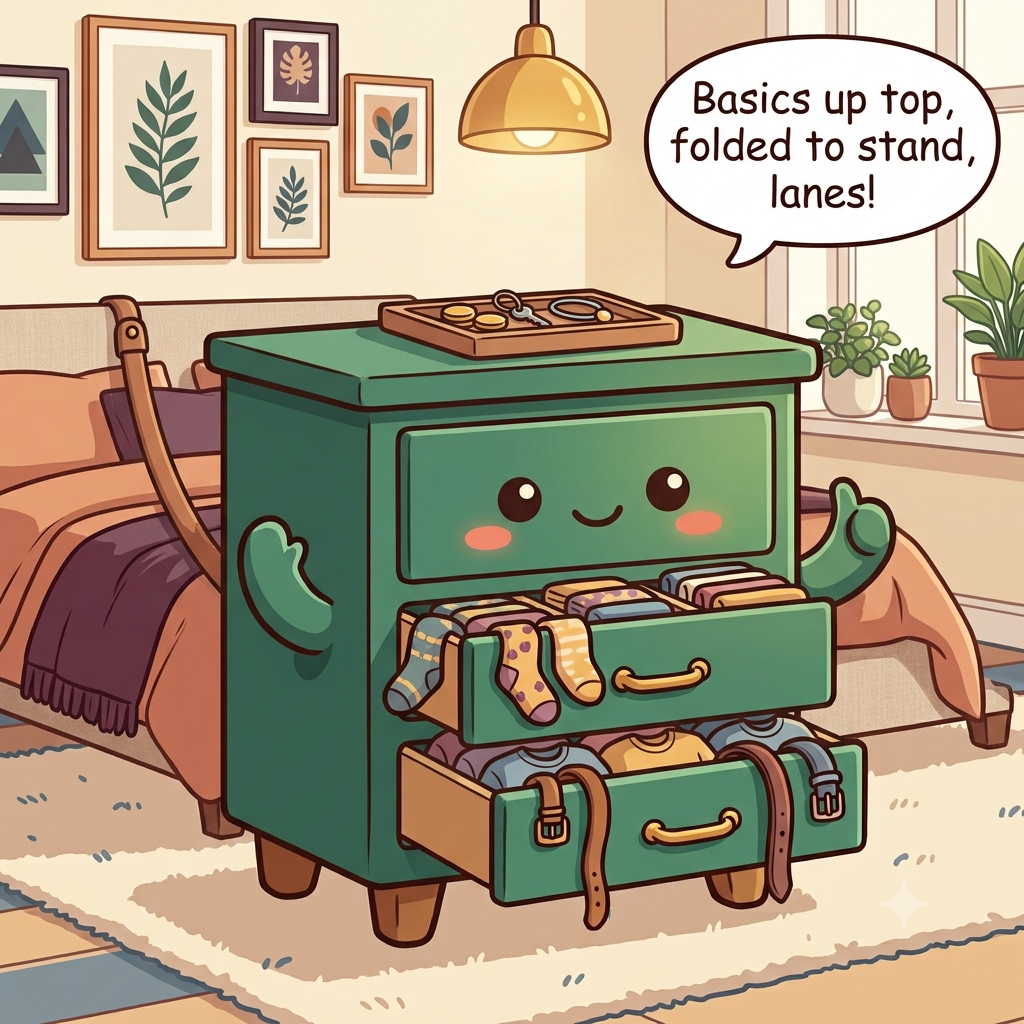
When garments hold their shape well, fold them into compact rectangles and stand them upright so every item is visible from above. This works especially well for T-shirts, leggings, pajamas, and many casual clothes. Adjust the fold to the drawer height rather than forcing one universal folding method.
Some bulky knits, delicate fabrics, or structured garments may be better stacked loosely or hung. Do not compress clothing so tightly that the row cannot move. Visibility is the goal; if you must excavate the bottom layer, the drawer is overfilled.
Adjust the fold to the actual drawer height so the row stays upright without being compressed. A standing fold is useful only when every garment remains visible and can be removed individually. Bulky knits and delicate fabrics may need a looser stack or another storage method rather than forced vertical folding. Test a full row after laundry day, when the drawer is at its real maximum. If garments must be compressed hard to close the drawer, remove some inventory or use another drawer. A standing fold needs enough lateral room to stay upright and readable.
Divide each drawer into lanes
Use adjustable dividers, small boxes, or fabric bins to create broad lanes such as socks, underwear, short sleeves, and long sleeves. Measure the drawer before buying inserts, especially the interior height under the rails. Leave enough flexibility for laundry-day variation.
Avoid dozens of tiny cells unless the category really benefits from them. A wide lane that fits a row of shirts is easier to maintain than a rigid organizer that only works when every item is folded identically. The divider should support the fold, not dictate the wardrobe.
Use flexible dividers to keep broad categories from drifting together, but leave enough room for normal laundry variation. Measure inside width and rail clearance before buying inserts. If an organizer requires every shirt to be folded to one exact size, it is likely too rigid for a household drawer. Keep socks or underwear in small sections only if the divider makes returns easier. Oversized bins can waste usable width, while tiny honeycomb organizers can become too rigid for changing clothing sizes. Use the simplest boundary that keeps categories from drifting together.
Keep the top to a tray and a lamp
Give the surface one small landing tray for daily pocket items or jewelry and keep only intentional essentials beside it, such as a lamp. Move laundry, receipts, cosmetics, and miscellaneous objects to their real homes before they become a permanent layer.
Do not place heavy televisions or tempting objects on top of a dresser unless the furniture is designed for the load and the TV is appropriately secured; CPSC advises anchoring TVs and furniture to reduce tip-over risk. In a child's room, keep climb-enticing toys and remotes off high dresser tops.
Limit the surface to intentional daily items and keep tempting toys, remotes, or heavy electronics off the top where they may encourage climbing or affect stability. If a television is used there, follow CPSC guidance for a sturdy appropriate base and secure both the TV and furniture as required. Keep the top clear enough that nobody is tempted to use open drawers as steps to reach a piled object. A low visual load also makes the anti-tip purpose easier to respect: nothing on top should invite a child to climb or an adult to overload the surface.
What breaks a dresser system
Do not overload top drawers with heavy objects, allow children to climb on drawers, or rely on furniture weight alone to prevent tipping. Avoid stacking clothes so high that the bottom layer disappears and using rigid organizers that reduce useful drawer height.
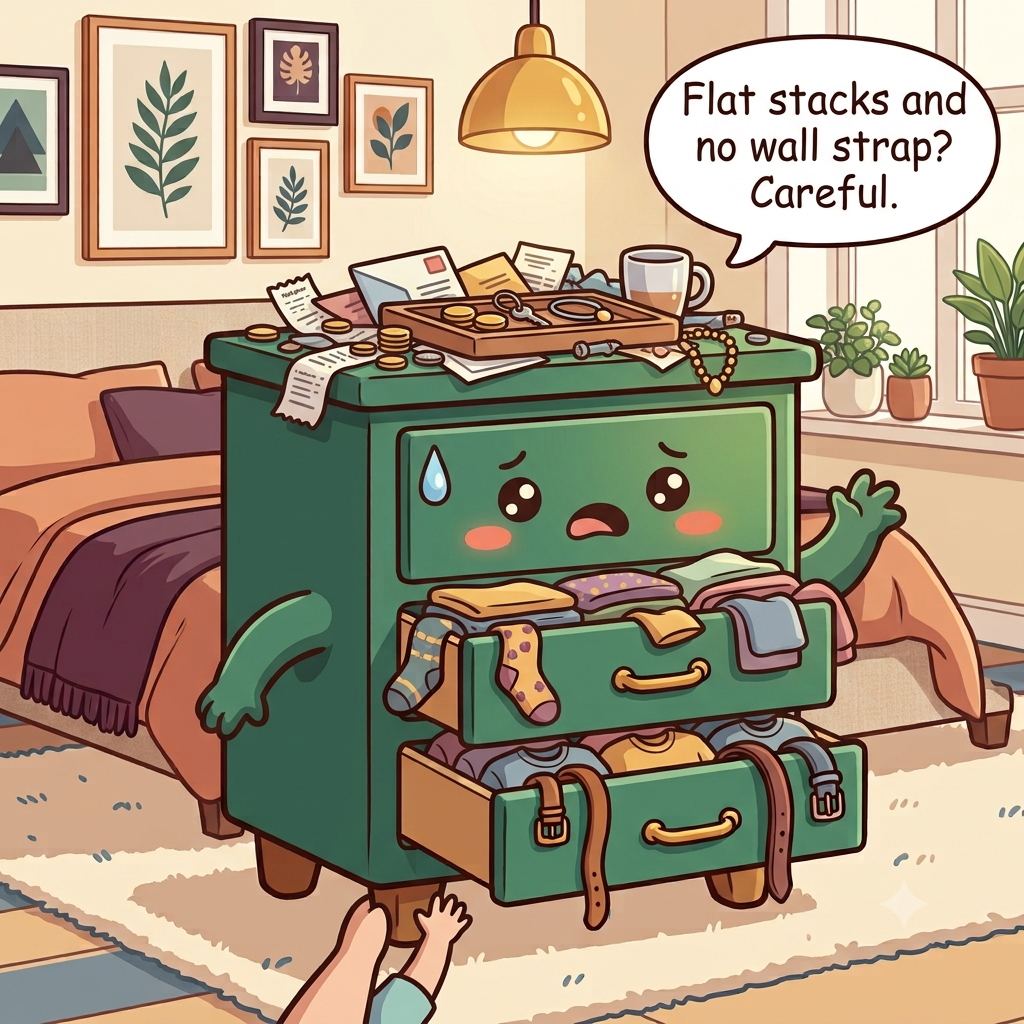
Do not turn the dresser top into a second closet shelf. If clean laundry repeatedly lands there, change the laundry return routine or reduce the drawer inventory so clothes can be put away immediately.
Do not rely on the dresser's weight alone to prevent tipping, let children climb open drawers, or open several loaded drawers at once. Avoid heavy objects high and overfilled top drawers. Anchoring, low weight placement, and a clear top are safety requirements, not styling preferences. Keep children from playing in or around open drawers and do not place climb-enticing objects above eye level. An anchored dresser is safer, but supervision and low heavy storage still matter.
The laundry-day reset
Put clean laundry away by lane instead of setting it on top for later. As you return each category, straighten one row and remove anything that no longer fits or gets worn. Close every drawer when finished.
Once a season, review the lowest-use garments and confirm the anti-tip hardware remains secure. A dresser stays organized when laundry can return without compressing every drawer to its limit.
Put clean clothes directly into their lanes instead of creating a temporary pile on the dresser top. As each drawer fills, remove outgrown, damaged, or unused pieces before compressing the row tighter. Periodically confirm the anti-tip connection remains secure and that drawers still open and close smoothly. If one drawer routinely stays half empty while another is crammed, rebalance the category map rather than adding more dividers. Drawer assignments should follow the current wardrobe, not the layout you created months ago.
Furniture tip-over safety
- Anchor dressers and other clothing-storage furniture securely to the wall using appropriate hardware.
- Keep heavier items in lower drawers.
- Do not place toys or other tempting items high where a child may climb drawers to reach them.
Source: U.S. CPSC — Anchor It
30-second success check
- The dresser is secured according to its anti-tip instructions and the restraint is intact.
- Heavy clothing or objects stay in lower drawers.
- Each drawer closes without compressing clothing hard or forcing the slides.
- The top is free of tempting climb targets and heavy unstable objects.
- Laundry can be returned without creating an overnight pile on the dresser top.
Questions that come up
Frequently asked questions
Part of Closets, Clothing & Personal Storage — 13 guides.