
The short answer
Use the closet depth deliberately: keep active linens at the front and put a clearly labeled reserve of the same category behind them rather than mixing unrelated items front to back. Store complete sheet sets together, assign shelves by frequency and weight, and use handled bins for small supplies you need to pull forward as a unit.
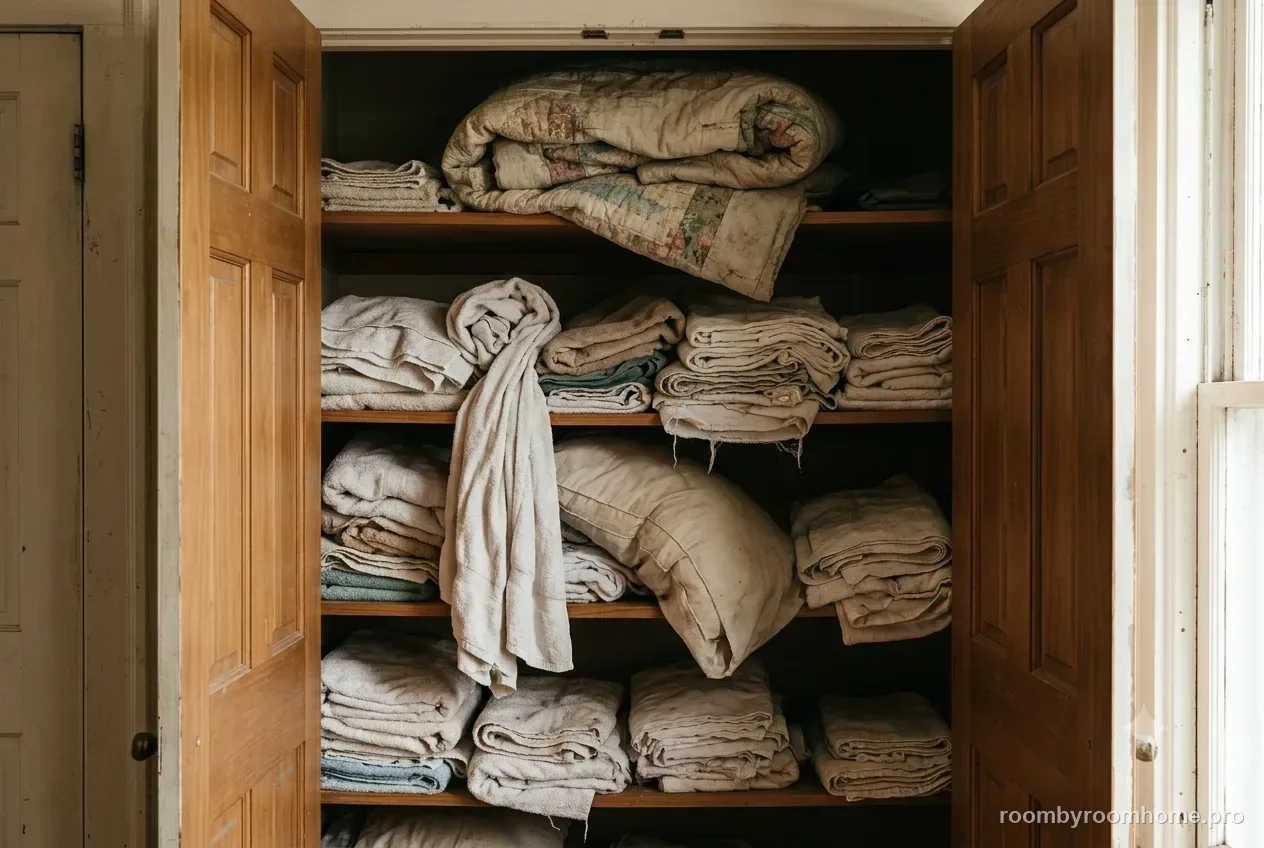
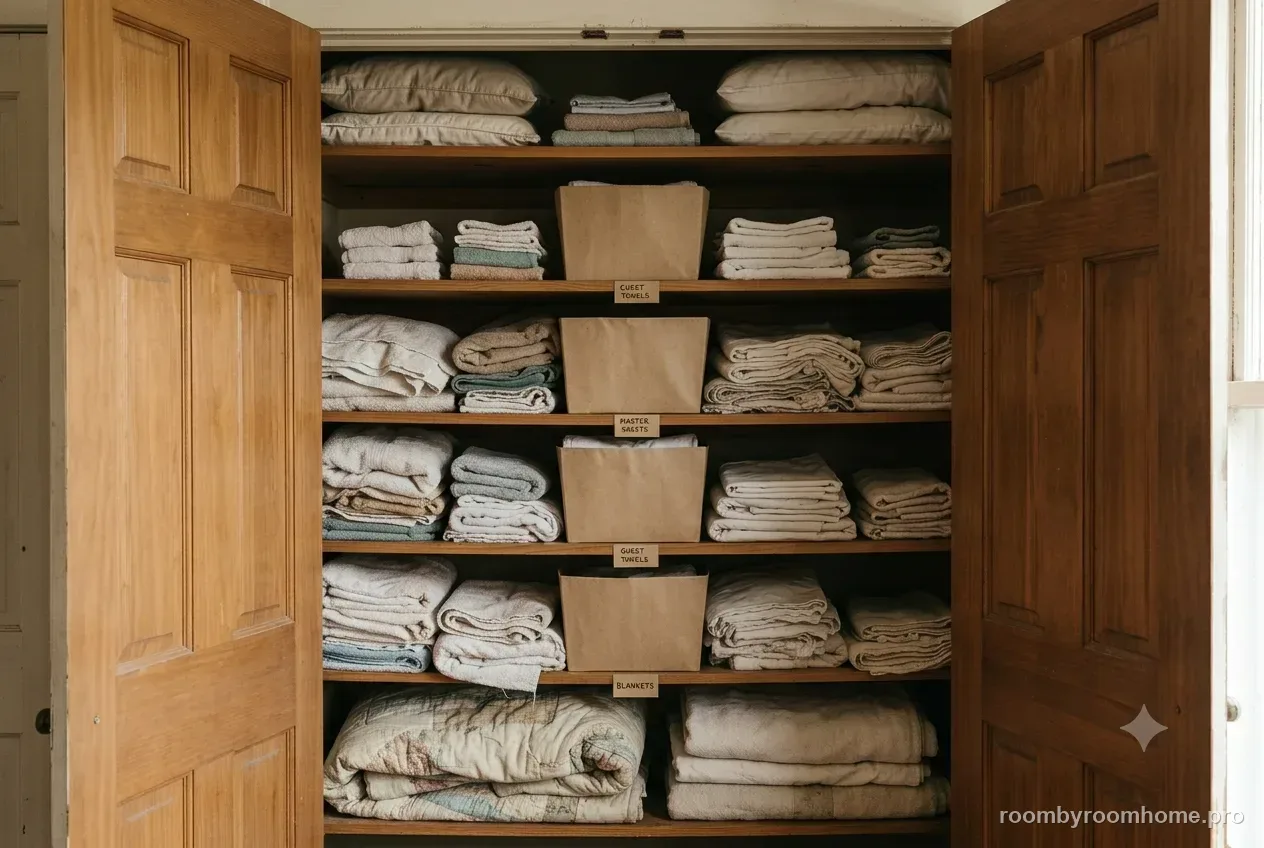
What to gather before you start
- Handled bins that match the shelf depth
- Shelf dividers for stable stacks
- A few breathable containers for small linens
- Labels for front and reserve zones
- A step stool suited to your household
- A donation or textile-recycling bag
Measure first. Buy only the pieces that solve a specific access problem.
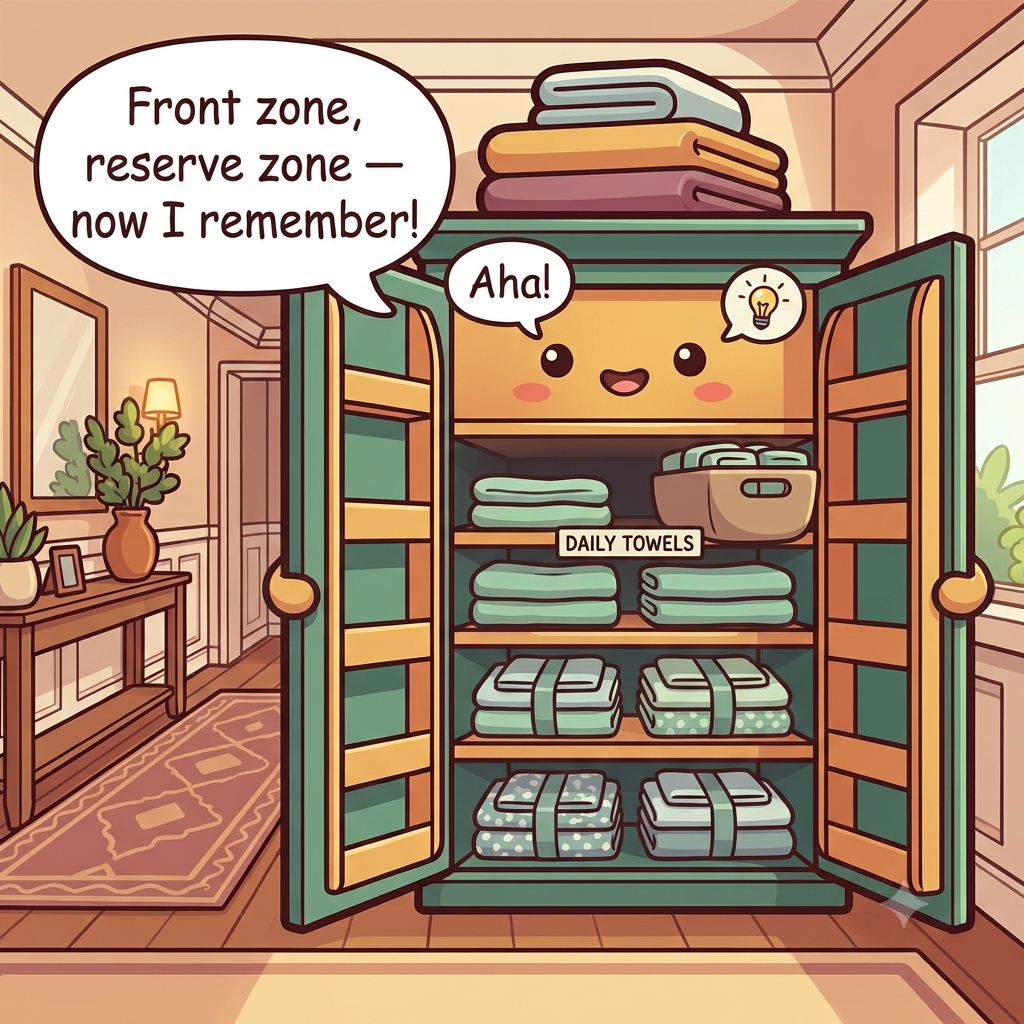
Split every deep shelf into a front zone and a reserve zone
Deep shelves work better when the back row is intentional reserve storage, not a second hidden pile.
- Measure shelf depth and the actual door opening before choosing bins.
- Keep one active category at the front of each shelf.
- Put reserve quantities of that same category directly behind it, ideally in a handled bin that can be pulled forward.
- Keep heavy stacks on lower shelves and light, less-used linens higher.
- Label the front edge or bin handle so the reserve inventory is readable from the aisle.
Empty one shelf at a time and keep sets together
Clear one shelf at a time so clean linens do not end up in a mixed pile on the floor. As each shelf comes out, match fitted sheets, flat sheets, and pillowcases into sets; pair towels by size; and separate worn, stained, or incomplete items for repair, rags, donation, or textile recycling where available.
Wipe and fully dry the shelf before restocking. Working shelf by shelf also shows you which categories are actually consuming the depth. If one shelf is mostly old toiletries or unrelated household overflow, relocate those items before buying more linen organizers.
As each shelf empties, measure usable depth and note how far you can comfortably reach without dragging down the front stack. Deep shelves often need containers that pull the back category forward as one unit. Keep sheet sets and matching towels together during sorting so the closet is organized around complete changes, not isolated pieces. Count complete usable sets while you sort so unmatched pillowcases and partial sheet sets do not quietly inflate the category. A smaller number of complete sets is easier to rotate than several incomplete piles.

Assign shelves by frequency and weight
Place everyday towels and frequently changed bedding between roughly waist and eye level where they are easy to lift. Put bulky but lighter guest bedding or seasonal blankets higher, and keep heavier bins lower so retrieval does not require pulling weight down from overhead. Give each shelf a main category instead of alternating towels, sheets, and toiletries in the same stack.
Keep a stable step stool nearby only if you can use it safely and the closet approach stays clear. Do not place glass containers or dense backstock on a high shelf. The deepest, hardest-to-reach spots are better for light reserve items that you can retrieve in a handled bin.
Put everyday towels and frequently changed sheets between roughly waist and eye level when your closet allows it, then use lower shelves for bulky or heavier blankets. Reserve the highest shelf for light, infrequent items you can control safely. The exact shelf assignment matters less than avoiding a heavy bin above a difficult reach.
Turn shelf depth into front and reserve zones
Treat each deep shelf as two lanes: active stock at the front and reserve stock directly behind the same category. For example, keep the current rotation of bath towels in front with the extra towels behind them, rather than hiding pillowcases behind bath towels. Use bins or shelf dividers so the back row can be pulled forward without disturbing the front.
Avoid building two unrelated rows of loose folded items. Deep shelves create forgotten inventory when the back is invisible, so labels should identify the reserve from the aisle. If a container is too deep to lift when full, use two smaller handled bins rather than one heavy box.
Label the reserve where it can be read from the aisle. If the active towels are in front, the back row should hold more towels—not a different category that will disappear for months. When one deep bin becomes too heavy to pull, split the category into two smaller handled containers rather than increasing the lifting load. Reserve zones should also be easy to audit: when the front supply gets low, pull the reserve forward and refill from the back instead of creating a new front stack beside it.
Store sheet sets as complete units
Keep each sheet set together so changing a bed does not require searching three shelves. Fold the fitted and flat sheets with one matching pillowcase, then place the bundle inside the other pillowcase or contain the set in a labeled bin. Label by bed size and, in a multi-bedroom home, by room if that makes retrieval faster.
Do not chase a perfect fold if it makes laundry day harder. The important part is that the entire set travels and returns as one unit. Keep only the number of sets that fits comfortably in the assigned zone; excess sets that never rotate make the active stack unstable and hide the ones you actually use.
Label complete sets by bed size, and by room when several beds use the same size. Keeping the fitted sheet, flat sheet, and pillowcases together reduces both search time and partial sets. If a set no longer has all of its usable pieces, either repurpose the remaining linen deliberately or remove it from the active-sheet zone.
Contain small supplies without hiding excess
Use shallow or handled bins for washcloths, spare toiletries, guest supplies, and small cleaning textiles. Choose a bin size that limits backstock instead of allowing a deep basket to become a black hole. Open or clear containers help with frequently used supplies; opaque bins need clear front labels.
Keep medicines and humidity-sensitive products out of a hot, damp linen closet if the closet shares bathroom humidity. Cleaning chemicals should stay in original labeled containers and be locked or placed out of children's reach. Avoid storing leaking bottles directly above clean linens.
Give small guest toiletries, washcloths, and backstock a shallow container with a visible limit. When the bin is full, use what is already there before buying more. Avoid storing leaking bottles above clean linens, and move medicine or other products that require cool, dry conditions out of a closet that regularly becomes humid from a nearby bathroom.
Habits that undo a deep linen closet
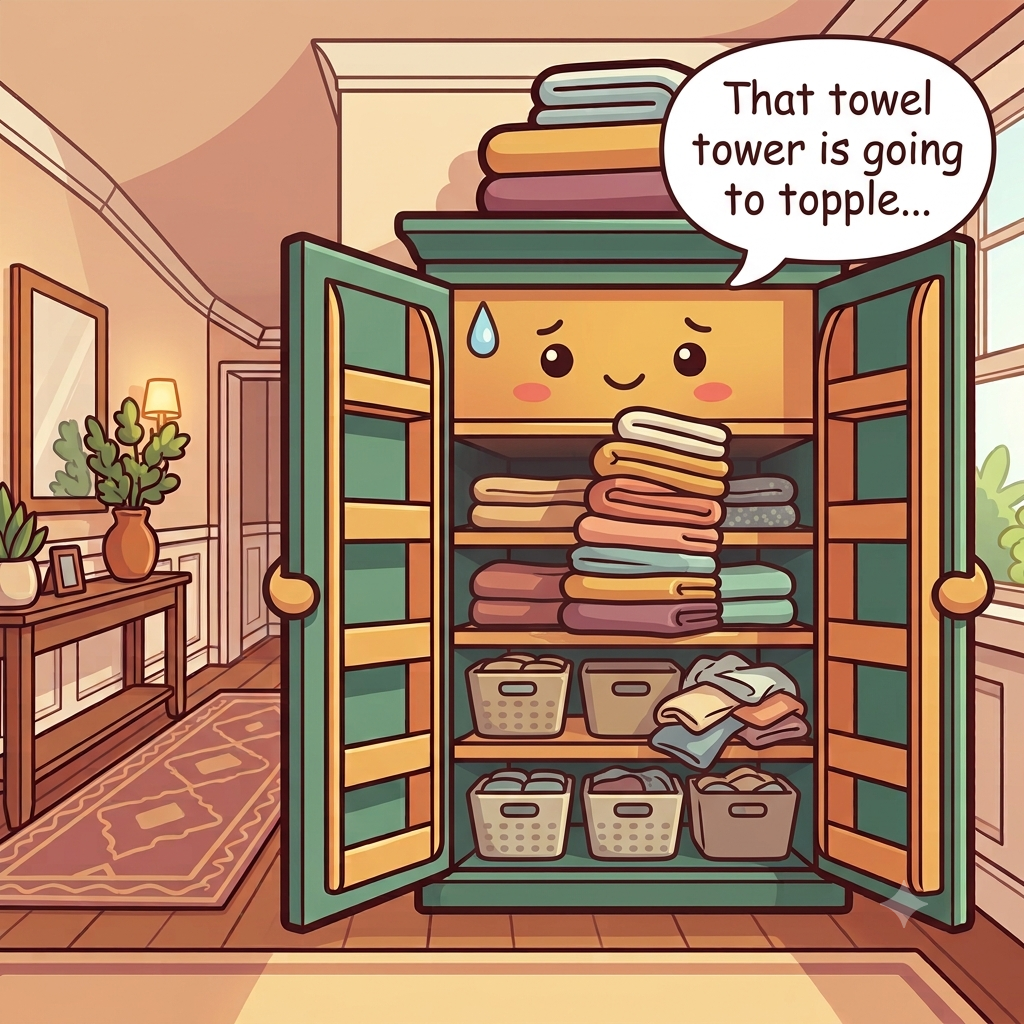
Do not stack towels to the ceiling, mix sizes in one unstable pile, or place unrelated categories in the invisible back row. Avoid cardboard boxes in a damp closet, unlabeled opaque bins on deep shelves, and heavy containers overhead. Do not keep yellowed, torn, or duplicate linens simply because there is space behind the active stack.
Another mistake is storing sets in separate categories—fitted sheets in one pile, pillowcases in another—when the household thinks in complete bed changes. Organize around the way the linen leaves the closet. If you pull a whole sheet set at once, store it as a whole set.
Avoid two unrelated rows of loose items, unstable towel towers, cardboard in a damp closet, and heavy opaque bins overhead. Deep shelves reward categories that can be pulled forward together. If the back row cannot be named from the aisle, it is already becoming forgotten inventory. Keep a donation bag or outgoing basket elsewhere in the home so worn linens can leave promptly instead of being pushed into the deepest shelf.
The laundry-day reset
When clean linens return, put them behind or beneath the same category so the older clean set is used first. Rebuild any leaning stack immediately rather than adding another item on top. If a bin is full, stop and edit before forcing the lid or compressing the shelf.
Once a month, pull the front items forward enough to check the reserve row for forgotten supplies. At seasonal changes, wash and completely dry blankets before storing them, then label the container with its contents so the back of the closet remains searchable.
Return clean sets behind or beneath the older clean set in the same category so the closet naturally rotates. Straighten a leaning stack before adding another item and stop when a labeled bin reaches its physical limit. Once a month, pull the reserve forward far enough to confirm that nothing has been stranded at the back. If the same blanket or towel never reaches the front through an entire season, decide whether it is emergency backstock, a guest item, or simply excess; give it a clear role or remove it.
Best use of deep linen shelves
Keep here
- Complete sheet sets stored together
- Towels grouped by type or person
- One controlled reserve of toiletries or paper goods if the closet is dry
- Light seasonal bedding on upper shelves
Store elsewhere
- Unlabeled mixed backstock
- Damp linens
- Dense heavy boxes overhead
- Items so deep or loose that the front row must be unloaded to retrieve them
30-second success check
- Current-use linens live at the front and reserve stock behind them belongs to the same category.
- Each sheet set can be removed as one complete unit.
- Heavy towels or blankets sit on stable lower or middle shelves rather than overhead.
- No frequently used item requires moving an unrelated bin from the back first.
Questions that come up
Frequently asked questions
Part of Closets, Clothing & Personal Storage — 13 guides.