
The short answer
Keep the coat closet focused on the current season. Edit the rod to coats that are actually being worn now, give wet boots and umbrellas a washable, ventilated floor zone, move off-season outerwear to labeled storage elsewhere, and limit non-coat items so the door and walkway stay clear.
What to gather before you start
- Matching slim hangers
- A lipped boot tray or waterproof mat for the floor
- A couple of handled bins for the top shelf
- Hooks for bags, scarves, or a dog leash
- A shelf divider or shelf riser
- Labeled bins for off-season and accessory storage
Measure first. Buy only the pieces that solve a specific access problem.
Take everything out and see what the closet is really holding
Remove coats, shoes, bags, umbrellas, sports gear, vacuums, and anything else that has migrated into the closet. Sort by person and by function, then identify what belongs to the entry routine versus what is simply using the closet as overflow. Check pockets before donating or storing coats and clean the floor and baseboards while the closet is empty.
Measure rod width, shelf height, and floor depth before adding organizers. Note whether long coats need full drop space and whether the door can support an over-door rack without rubbing the frame. Renters can use over-door hooks, removable hooks within their load rating, tension solutions, or freestanding shoe racks instead of drilling.
Before adding hardware, record the rod length, top-shelf depth, door swing, and usable floor area after the door closes. Hang the longest coat back temporarily so you can see the real drop it needs. That simple test prevents a shoe rack, drawer unit, or vacuum from occupying the exact floor space required by long outerwear. While the closet is empty, check for damp flooring, loose shelf supports, and a rod that sags under coats. Fix those physical problems before storage returns; bins and thinner hangers cannot compensate for weak hardware or trapped moisture.
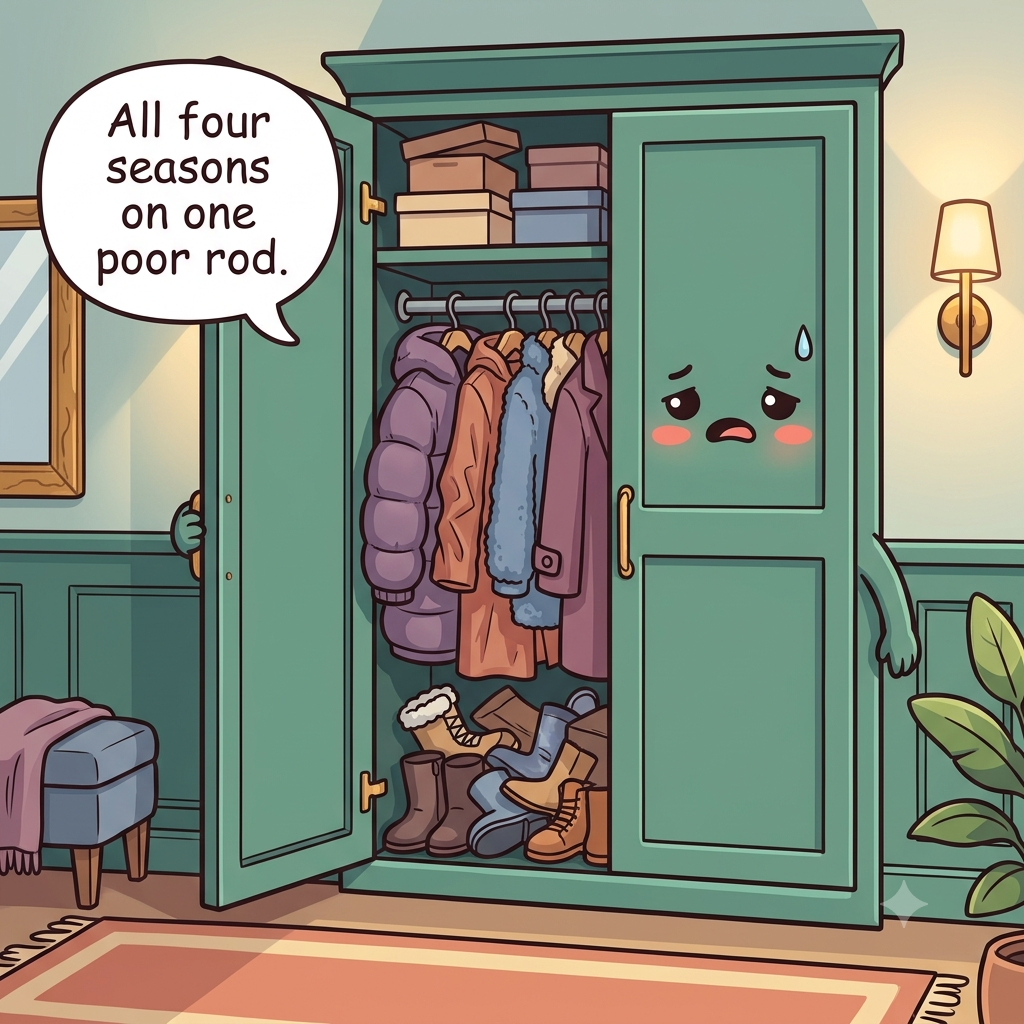
Keep only the season you're in on the rod
Put current-season coats and jackets on the main rod and give each regular user a reasonable section. Remove coats that do not fit, are damaged beyond repair, or were not worn during the last comparable season. Bulky winter coats can consume several times the rod space of light jackets, so seasonal editing has a larger effect than thinner hangers alone.
Leave enough room for guests or a temporarily wet coat without crushing the entire row. If every hanger is packed shoulder-to-shoulder, move occasional formal outerwear or backup coats elsewhere. The active rod should support daily retrieval, not display the household's full outerwear inventory.
Use movement, not a fixed coat count, as the capacity limit. Hangers should slide enough to identify and remove one coat without dragging several others along. Keep a little spare rod space for a guest coat or a wet jacket waiting to dry; if that margin disappears, move backup or off-season outerwear elsewhere.
Rotate the seasons instead of storing them all here
At the end of the season, clean outerwear before storage and move it to labeled bins, garment bags, or another closet that is dry and appropriate for textiles. Store only clean, fully dry items so soil and moisture are not sealed in for months. Keep the next season's most-used pieces easy to retrieve rather than burying them behind unrelated storage.
Use one clearly labeled container per person or category when possible, and avoid overfilling soft garments until they are permanently crushed. If you use an attic, basement, or garage for seasonal clothes, first make sure the space is dry and temperature conditions are appropriate; damp or extreme environments can damage textiles and leather.
Label seasonal storage by person or garment type and note where it lives so the next swap is retrieval, not excavation. Clean and fully dry coats before long storage, and avoid damp basements, hot attics, or garages for leather and other materials that need more stable conditions. Check care labels before using compressed or sealed storage. Keep care labels with specialty coats and avoid long-term plastic dry-cleaning bags unless the garment maker specifically recommends them. Breathable garment protection is often more suitable for textiles that need air circulation, but the care instructions for the actual material take priority.
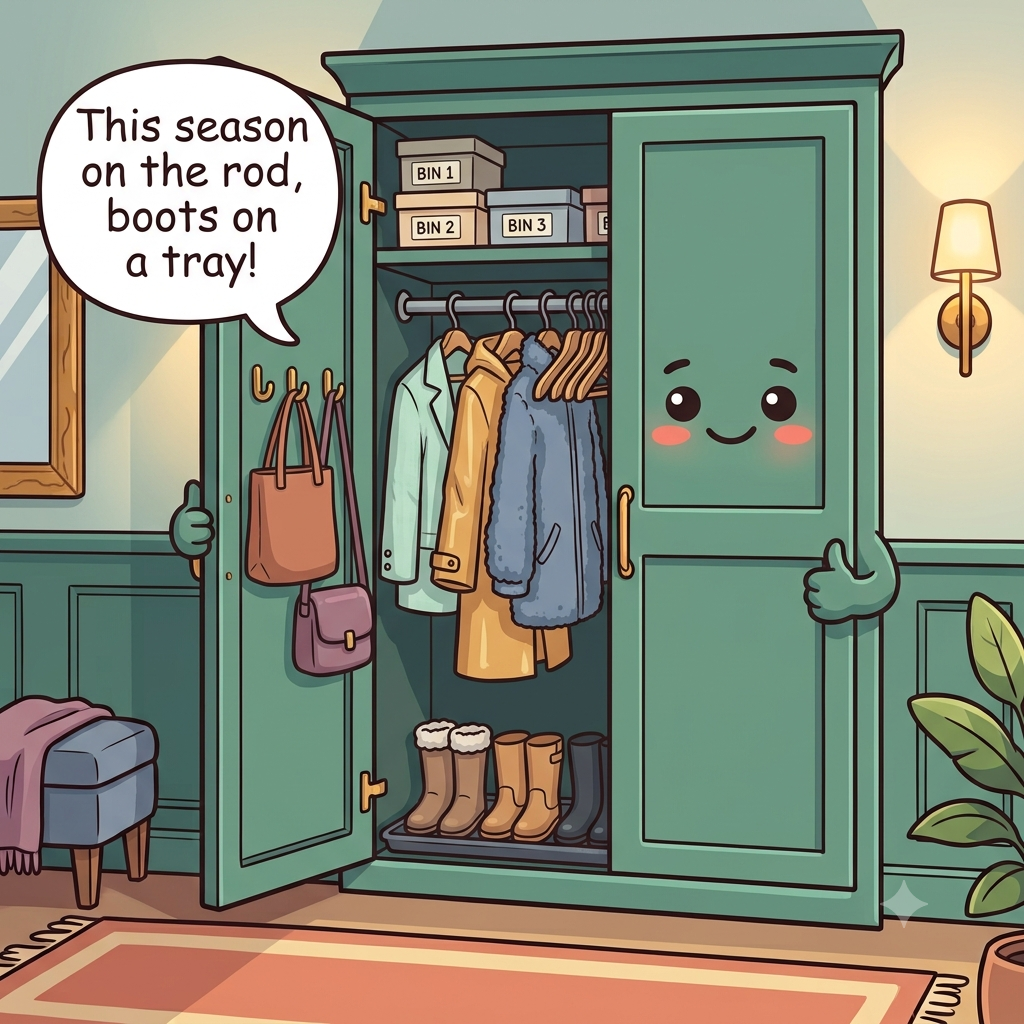
Give boots and wet gear a floor that can take it
Use a boot tray, washable mat, or ventilated shoe rack on the closet floor so wet soles do not sit directly on wood or carpet. Allow boots, raincoats, and umbrellas to dry before closing them into a crowded closet. If the closet has poor airflow, dry soaked gear outside the closet first.
Keep tall boots upright enough that they do not block the door or fall into the walkway. Empty standing water from umbrella holders and clean salt and mud from trays regularly. A wet-zone boundary protects the floor and also shows when too many pairs are competing for daily space.
Choose a tray or mat that can be removed and washed without lifting the entire closet contents. Keep wet items separated from cardboard boxes and clean textiles, and let soaked gloves or coats dry in open air before they return to a closed closet. If moisture repeatedly reaches the baseboard or wall, improve drying rather than adding another liner. If several people arrive with wet footwear at once, size the washable zone for the household's real peak use rather than the neatest-looking pair of boots. Anything beyond that footprint should dry elsewhere instead of spreading across the closet floor.
Decide what non-coat things are allowed to live here
Choose a short approved list: perhaps the vacuum, a small basket of reusable bags, or one sports bag. Give each item a fixed footprint that does not obstruct coats, the door, or access to the floor. Anything that cannot fit inside its assigned boundary should move to a more appropriate storage area.
If cleaning chemicals or other hazardous products share the closet, keep them high and locked or otherwise secured in homes with children, in original labeled containers, and separated from clothing where leaks could cause damage. Never decant cleaners into food or drink containers and never mix products.
Mark the footprint for any approved non-coat item so it cannot spread. A vacuum should still roll out without moving boots, and reusable bags should fit in one basket rather than on every hook. If chemicals share the closet, keep them in original containers and locked away from children instead of relying on a high shelf alone. Write the approved non-coat list on the inside of the door if overflow is a recurring problem. That simple boundary makes it easier to reject random bags, tools, or pantry stock before they become permanent closet residents.
Habits that undo a coat closet
Do not keep four seasons of coats on one short rod and then solve the crowding with more hooks. Avoid sealing wet coats in an unventilated closet, putting boots directly on vulnerable flooring, and storing heavy objects on a high shelf where they can fall during retrieval. Do not let vacuum hoses or bags block the door swing.
Another mistake is using the top shelf as an anonymous pile. Use a small number of labeled bins for light seasonal accessories such as hats, gloves, or scarves, and keep heavy storage elsewhere. If a category cannot be reached safely, it is in the wrong location.
Do not let the top shelf become a heavy, anonymous archive or pack the rod so tightly that damp coats cannot air. Avoid floor storage that blocks long hems or the door, and do not use weak over-door hardware for dense bags. When the closet overflows, reduce seasonal inventory before multiplying hooks.

The twice-a-year reset
At the start of warm and cold seasons, swap outerwear, wash or clean items as appropriate, check fit, and remove pieces that no longer serve anyone. Wipe the boot tray, vacuum the floor, and verify that each person's daily section still matches real use.
During the season, a weekly thirty-second check is enough: hang stray coats, pair gloves, and move dry boots back to their spots. Seasonal rotation does the heavy work so daily maintenance stays small.
Use each seasonal swap to inspect the closet hardware as well as the clothes. Tighten or correct loose hooks according to their instructions, clean the wet-gear zone, and remove anything that no longer fits the household's current season. Between swaps, a brief weekly return of coats, shoes, and accessories should be enough.
Chemical storage in a shared closet
- If cleaners or household chemicals share the closet, keep them in original child-resistant containers and secured from children.
- Do not decant household chemicals into food or drink containers.
- Keep wet gear separated from chemicals and clean textiles so leaks or drips are easy to notice.
Source: U.S. CPSC — Poison Prevention
Renter-friendly option
Use over-door hooks, a freestanding shoe rack, shelf dividers, and labeled bins before adding permanent closet hardware. Do not overload the existing rod or door.
30-second success check
- The prime rod holds the current season rather than every coat owned.
- The longest coat hangs without resting on a shoe rack, vacuum, or floor pile.
- Wet boots and outerwear have a washable drying zone before they re-enter closed storage.
- Any approved non-coat item fits its fixed footprint without blocking the door or coats.
- If chemicals share the closet, they remain original-labeled and secured from children.
Questions that come up
Frequently asked questions
Part of Closets, Clothing & Personal Storage — 13 guides.