
The short answer
Treat the attic as storage only if its structure, access, ventilation, moisture conditions, and local requirements make that use appropriate. Keep heat- and humidity-sensitive belongings elsewhere, preserve soffit and other ventilation paths, use a permanent safe walkway rather than stepping on insulation or unsupported ceiling surfaces, keep storage low and light, and label bins so everything can be retrieved from the aisle without crawling into the eaves.
What to gather before you start
- A flashlight or headlamp
- A tape measure and painter's tape
- Sturdy sealed bins sized for safe lifting
- Large readable labels on two sides
- A stable attic-rated walkway or decking where appropriate
- A dust mask and gloves appropriate to the conditions
Measure first. Buy only the pieces that solve a specific access problem.
Decide whether the attic is storage space before treating it like storage space
First determine whether the attic has a safe access route and a floor or platform designed to support people and stored loads. Many attics have exposed joists, insulation, wiring, ducts, and ceiling surfaces that are not storage floors. If structural capacity or permitted storage areas are unclear, consult the building plans, a qualified professional, or local requirements rather than guessing from appearance.
Do not step on drywall ceilings or compress insulation to create an improvised path. Storage is optional; damaging insulation, wiring, ventilation, or structure to gain capacity is not. Keep electrical boxes, HVAC equipment, and other service areas accessible.
Confirm that the attic is designed and safe to enter before treating any part of it as storage. Ceiling drywall and insulation are not walking surfaces, and truss or joist loading is a structural question rather than an organizing estimate. If there is no proper platform, walkway, lighting, or safe access, keep storage elsewhere until a qualified professional has evaluated what can be supported. Organization begins after the space is physically suitable.

Keep heat- and moisture-sensitive belongings out
Attics can become extremely hot, cold, and humid compared with living spaces. Keep medicines, candles and wax, many electronics, photographs, important papers, delicate textiles, musical instruments, and other temperature- or moisture-sensitive belongings in conditioned storage unless the product or material guidance specifically allows attic conditions.
Use the attic only for durable items that tolerate its environment, and keep them in containers appropriate for dust and pests. Avoid cardboard where leaks or humidity are possible. If the attic is persistently damp, address the moisture and ventilation problem rather than expanding storage; EPA guidance for indoor spaces is to keep relative humidity below 60%, ideally 30–50% where possible.
Move heat-, cold-, and moisture-sensitive belongings to conditioned space. Photographs, important papers, medicines, many electronics, candles, delicate fabrics, and items with adhesives can be damaged by attic temperature swings or humidity even when they are sealed in a tidy bin. Keep only belongings that tolerate the actual attic environment, and inspect manufacturer storage limits for anything valuable rather than assuming a plastic tote makes the temperature irrelevant.
Build a low, light storage zone around a permanent walkway
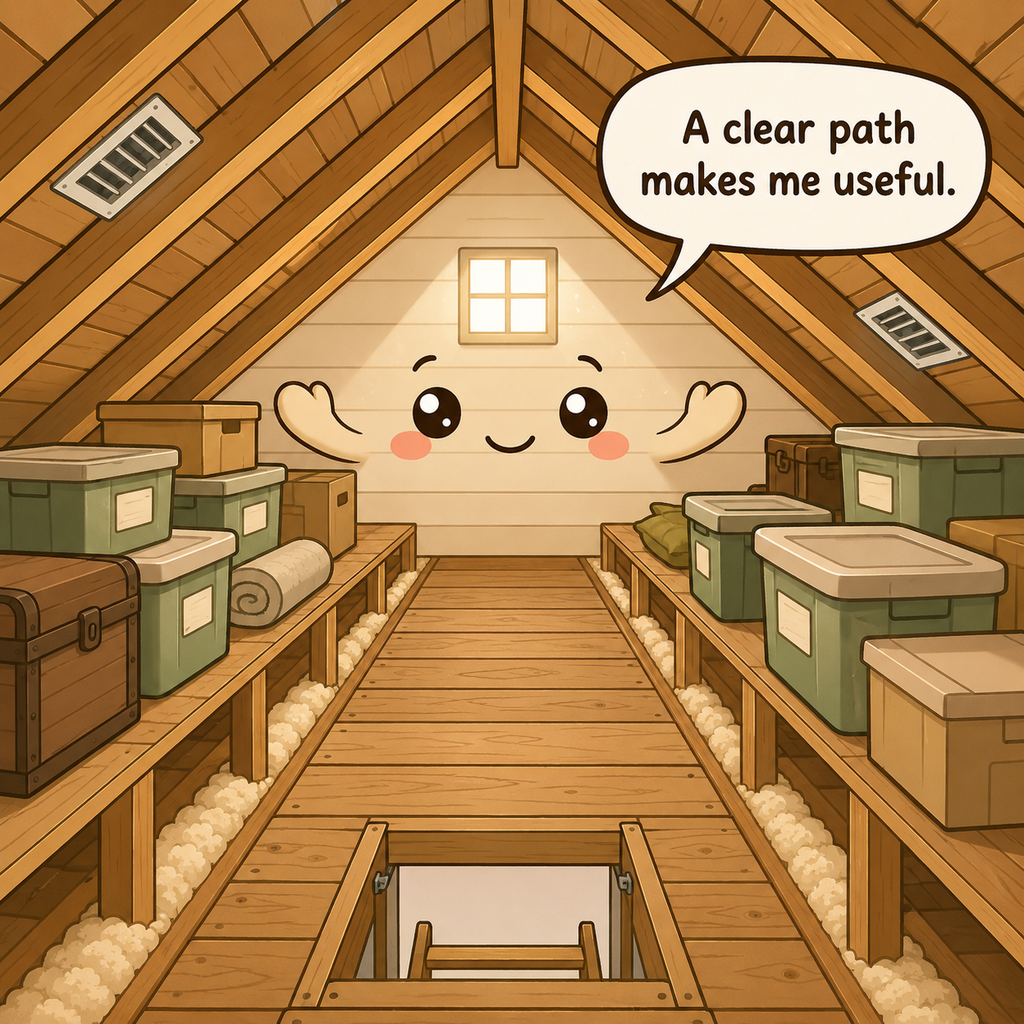
Keep bins on a proper storage deck or shelving designed for the attic, not directly on insulation. Maintain a clear permanent walkway from the access point to every stored category and to equipment that may need service. Put heavier permitted items closest to the supported floor and avoid tall stacks beneath a sloped roof.
There is no universal safe attic storage weight because framing, spans, construction, and local requirements vary. Do not invent a pounds-per-square-foot rule from a generic website; confirm the structure's capacity when load matters.
Keep storage low and light along a verified platform or designed storage area, with a permanent walkway from the access point to every bin. Do not bridge exposed joists with loose boards or step on drywall. Heavy bins make attic retrieval more dangerous on ladders and narrow platforms, so divide bulky categories into smaller containers one person can handle. Leave electrical boxes, equipment, and service areas reachable rather than walling them behind seasonal stock.
Protect ventilation instead of filling the eaves
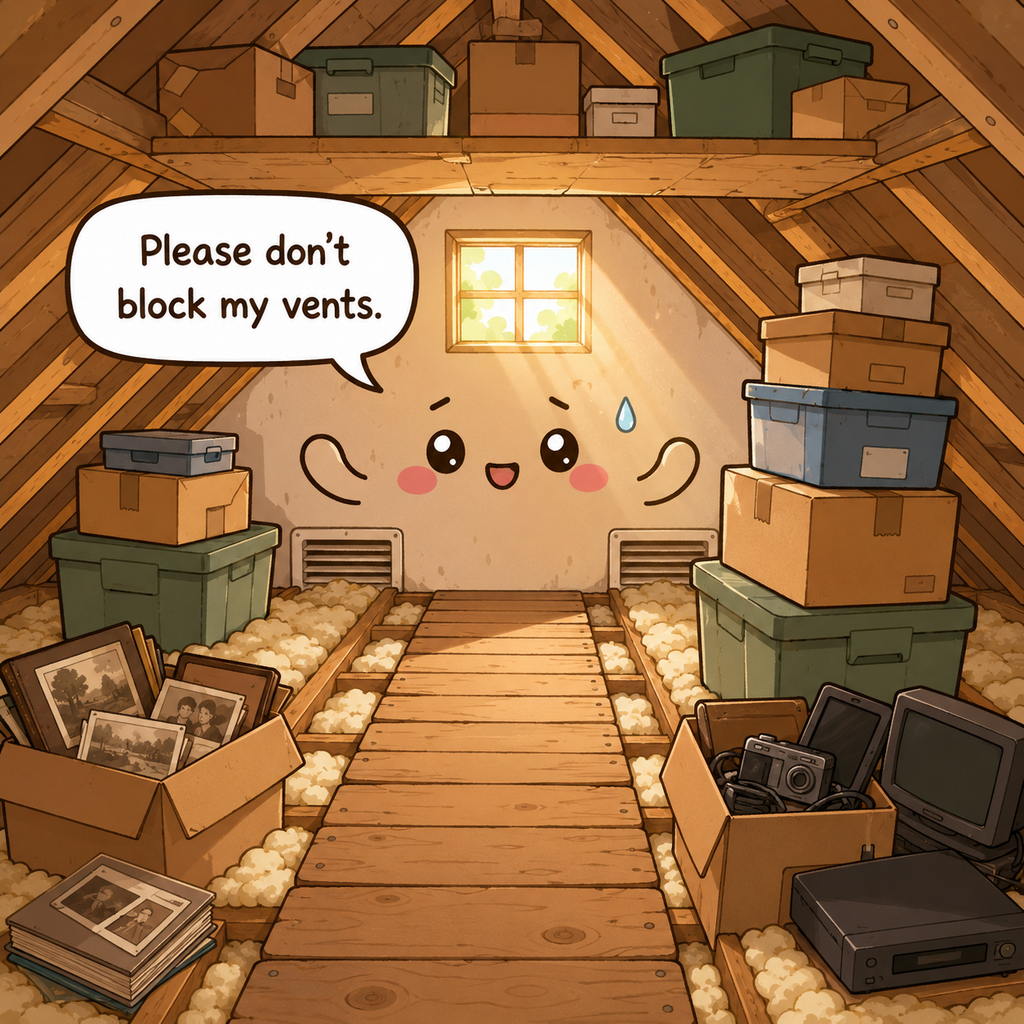
Keep soffit vents, ridge vents, gable vents, baffles, and other designed air paths open. DOE guidance uses baffles to preserve airflow from soffit vents at the eaves; storage should not crush, displace, or cover those ventilation components. Leave access to inspect roof leaks and insulation at the perimeter.
Keep soffit vents and the airflow channel at the eaves open. ENERGY STAR guidance says insulation should not cover soffit vents and describes rafter vents or baffles that preserve the air path; storage should stay clear of those channels too. Do not push bins into the eaves when you cannot confirm what ventilation or wiring is present there.
Use a flashlight from the permanent walkway and make sure you can still identify the soffit openings, baffles or rafter vents, roof-edge insulation, and any wiring or equipment before storage is returned. If a bin hides the airflow path or prevents inspection of the eave, pull the storage boundary back. The success test is simple: ventilation components remain visible and serviceable without moving a stack of boxes.
Label for retrieval from the aisle, not for a photo
Place large labels on the end of each bin facing the walkway and use broad categories such as 'winter decor,' 'camping,' or 'empty luggage.' Keep a simple index near the attic access if several similar bins share one zone. The goal is to locate a box without moving or climbing over another stack.
Use containers with secure lids and handles appropriate to the load. Do not make bins so heavy that they cannot be carried safely through the attic opening or down the ladder. Split dense categories into smaller containers even if a single large tote would technically fit.
Label the end of each bin that faces the walkway and use broad retrieval names such as 'winter bedding' or 'holiday lights.' A lid label that looks neat in a photo is useless when bins are stacked at floor level. Keep a simple inventory near the attic entrance or digitally, including the row or side where a category lives. The goal is to retrieve one bin without stepping off the safe walkway or moving a tower of unrelated boxes.
Use the sloped roof as a boundary, not a shelf
Keep storage away from roof decking, exposed nails, vents, and tight eave spaces. Do not lean large objects directly against rafters or roofing components where they can interfere with inspection or trap moisture. Treat the lowest roof line as a no-storage boundary unless a designed shelf keeps items safely clear of building components.
Keep enough clearance to see stains, condensation, pest activity, roof damage, wiring, vents, and any utility or service components. A packed eave can hide the first sign of a leak or block access until both the building and stored belongings are damaged.
Treat the roof slope as the outer boundary of storage, not a place to wedge tall objects. Keep bins away from roof decking, soffit areas, vents, wiring, and any equipment that needs inspection. Do not hang objects from trusses or alter structural members to create storage without professional design. Sloped corners that cannot be safely reached from the walkway should remain empty; unusable cubic feet are not lost storage capacity.
Make the attic inventory small enough to inspect
Limit categories so every bin can be seen and reached from the walkway. Keep only durable seasonal items with a real future use, and donate duplicates instead of building a second row. A small inventory makes it possible to inspect for leaks, pests, and ventilation problems during each visit.
Record what enters and leaves if the attic is rarely accessed. The inventory does not need serial numbers; a short list by zone is enough to prevent buying duplicate holiday supplies because the existing box is invisible.
Keep the attic inventory small enough that you can visually inspect the roof underside, ventilation paths, stored containers, and walkway during a seasonal visit. If every inch is packed, leaks, pests, and damaged bins can stay hidden. Limit each category to a defined number of light containers and remove duplicates when that limit is exceeded. Rarely used possessions are not automatically good attic candidates if their material cannot tolerate the environment.
Where attics fall apart
Do not step on ceiling drywall, compress insulation, block soffit vents, crowd service equipment, or assume attic framing can carry arbitrary storage weight. Avoid cardboard and sensitive papers or electronics in hot or damp attic conditions, and do not create tall stacks under a sloped roof.
Another mistake is maximizing eave space until inspection becomes impossible. Ventilation, structural safety, and access come before storage density.
Common attic mistakes are structural and environmental, not merely visual: stepping off the platform, storing directly on insulation, blocking soffit vents, placing heavy bins high, or keeping sensitive documents and electronics in extreme temperatures. Do not quote a universal attic load limit because construction varies. When safe load, access, wiring, or ventilation is uncertain, use conditioned storage elsewhere and get qualified advice before adding a platform or shelving.
The seasonal reset
At each seasonal visit, inspect the walkway and visible roof areas for leaks, pests, condensation, displaced insulation, or blocked vents before adding or removing bins. Return containers with labels facing the aisle and remove anything that has become too heavy, damaged, or unnecessary.
If you discover moisture, structural movement, damaged wiring, or uncertain flooring, stop expanding storage and address the building issue first. An attic reset should verify the space as well as the belongings.
At each seasonal visit, inspect for roof staining, condensation, pests, crushed ductwork, blocked soffit paths, damaged bins, and changes to the walkway before moving anything. Keep the visit short enough to work safely in the attic temperature. Remove any category that has become too heavy or sensitive for the space, and restore a clear path to service points. If you find moisture, address the source before returning storage.
Heat, moisture & ventilation
- Do not treat an attic as general storage until you know the structure and access are suitable for storage loads.
- Keep vents and soffit airflow paths open.
- Move heat- or moisture-sensitive belongings to conditioned space and avoid storage that compresses or covers insulation inappropriately.
Sources: ENERGY STAR — About Attic Ventilation; U.S. EPA — Mold, Moisture and Your Home
30-second success check
- Storage exists only on a verified safe platform or designed storage area with a permanent walkway.
- Soffit vents, baffles, and other ventilation paths remain visible and unobstructed.
- Heat- or moisture-sensitive belongings have been moved to conditioned storage.
- Bins are light enough to handle safely through the attic access and can be retrieved from the aisle.
- Roof, wiring, equipment, and stored containers remain inspectable without dismantling a wall of boxes.
Questions that come up
Frequently asked questions
Part of Garage, Laundry, Attic & Basement — 6 guides.